
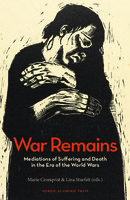
War Remains
Kriterium
Mediations of Suffering and Death in the Era of the World Wars
 Download
 Web Shop
Contributor(s)
Cronqvist, Marie (editor)
Sturfelt, Lina (editor)
Language
EnglishAbstract
War Remains is an interdisciplinary anthology dealing with the mediations and sense-making narratives of war deaths and suffering in the era of the world wars. In the first half of the 20th century, more than 120 million people died an untimely or violent death – on the battlefield, in concentration camps, through fierce air strikes or as casualties of the many epidemics and hardships that followed on the heels of war. The experiences and narratives of war that flowed through different media of the time were often focused on the emotional, the personal, the everyday, and the subjective. The horrifying experiences of mass death lingered on in cultural narratives for years, repeating, reinforcing, and renegotiating people’s beliefs about war and suffering.
The authors apply perspectives from a variety of scholarly fields such as history, media history, human rights studies, journalism, film studies, comparative literature, publishing studies, and rhetoric. Focusing on the period between the 1910s and 1970s, they show how literary fiction, newspapers, radio, film, comic books, and weekly magazines communicated the realities of war and turned the trauma into something that could be situated within the conventions of public display.
The book consists of an introduction by the editors, seven individual cases by different authors, and the editors’ postscript. In the introduction chapter by Cronqvist and Sturfelt, the book is placed within the research fields of the cultural history of war and sensing and mediating war. These discussions lead up to an argument for a new and innovative way of studying the subject by bridging the gap between historical studies on memory and media studies of memory, and instead apply an interdisciplinary perspective of a media history of war remains. This approach insists on the importance of media forms and historical context for remembering and sensing war.
The following seven individual chapters draw on a diverse range of sources and empirical examples to offer a comparison of different forms and expressions of media over an extended period. In chapter 2, Qvarnström analyses the First World War novels by the Swedish author Anna Lenah Elgström and discusses fiction as media. In chapter 3, Sturfelt analyses Save the Children’s humanitarian reporting and the visual discourses on starving children in the interwar period. Chapter 4 by Skoog examines the BBC radio correspondent Audrey Russell reporting and remembering the Second World War. In chapter 5, Bergström analyses media strategies and films by the Swedish European Aid in the late 1940s. In chapter 6, Cronqvist deals with memory, mediation, and decentring in John Hersey’s ‘Hiroshima’ from 1946. Chapter 7 by Kärrholm analyses motifs, paratexts, and other framing devices in EC’s Cold War comics. Finally, in chapter 8, Saarenmaa examines the circulation of Nazi imagery and generational layers of cultural remembrance in men’s magazines in the 1960s and 1970s.
In the postscript, the editors Cronqvist and Sturfelt summarize the core arguments of the book: the significance of war representations alongside media forms, the importance of the visual, the value of shifting temporal and spatial foci, the highlighting of gendered aspects of war remains, and the intractable focus on the remembering and grieving survivor. They then suggest some possible directions for future research within the field and end up emphasizing the value of a media history of war remains for understanding both past and present conflicts.
Keywords
1910s–1970s; interdisciplinary perspectives; mass death; suffering; war remains; cultural history of war; mediation; World War era; sensing war; cultural history; memory studies; human rights; media history; Journalism; Nazism; SwedenDOI
10.21525/kriterium.9ISBN
9789188661012, 9789187675818OCN
1076652590Publisher
KriteriumPublication date and place
Gothenburg, 2018Classification
Social and cultural history
Military history
Media studies
Social and ethical issues