Logo Oapen
  • Join
    • Deposit
    • For Librarians
    • For Publishers
    • For Researchers
    • Funders
    • Resources
    • OAPEN
        View Item 
        •   OAPEN Home
        • View Item
        •   OAPEN Home
        • View Item
        JavaScript is disabled for your browser. Some features of this site may not work without it.

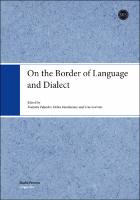
        On the Border of Language and Dialect
        Thumbnail
        Download PDF Viewer
        Contributor(s)
        Palander, Marjatta (editor)
        Riionheimo, Helka (editor)
        Koivisto, Vesa (editor)
        Language
        English
        Show full item record
        Abstract
        "This volume considers the linguistic borders between languages and dia­lects, as well as the administrative, cultural and mental borders that reflect or affect linguistic ones; it comprises eight articles examining the mental borders between dialects, dialect continua and areas of mixed dialect, language ideologies, language mixing and contact-induced language change. The book opens with Dennis R. Preston’s review article on per­ceptual dialectology, showing how this field of study provides insights on laymen’s perceptions about dialect boundaries, and how such perceptions explain regional and social variation. Johanna Laakso problematizes the common notion of languages as having clear-cut boundaries and stresses the artificialness and conventionality of linguistic borders. Vesa Koivisto introduces the Border Karelian dialects as an example of language and dialect mixing. Marjatta Palander and Helka Riionheimo’s article examines the mental boundaries between Finnish and Karelian, demonstrated by the informants when recalling their fading memories of a lost mother tongue. Niina Kunnas focuses on how speakers of White Sea Karelian perceive the boundaries between their language and other varieties. Within the framework of language ideology, Tamás Péter Szabó highlights the ways in which linguistic borders are interactionally (co)constructed in the school environment in Hungary and Finland. Anna-Riitta Lindgren and Leena Niiranen present a contact-linguistic study investigating the vocabulary of Kven, a variety lying on the fuzzy boundary of a language and a dialect. Finally, Vesa Jarva and Jenni Mikkonen approach demographically manifested linguistic boundaries by examining the Old Helsinki slang, a mixture of lexical features derived from Finnish and Swedish. Together, the articles paint a picture of a multidimensional, multilingual, variable and ever-changing linguistic reality where diverse borders, boundaries and barriers meet, intertwine and cross each other. As a whole, the articles also seek to cross disciplinary and methodological boundaries and present new perspectives on earlier studies.
        URI
        http://library.oapen.org/handle/20.500.12657/29742
        Keywords
        minority languages; language ideology; multilingualism; dialect; slang; borrowing; Finland; Finnish language; Karelia; Karelian language; Kven people; Loanword; Swedish language
        DOI
        10.21435/sflin.21
        ISBN
        9789522229168; 9789518580037; 9789518580044
        OCN
        1051778170
        Publisher
        Finnish Literature Society / SKS
        Publication date and place
        Helsinki, 2018
        Series
        Studia Fennica Linguistica, 21
        Classification
        Sociolinguistics
        Historical and comparative linguistics
        Pages
        262
        Public remark
        Relevant Wikipedia pages: Dialect - https://en.wikipedia.org/wiki/Dialect; Finland - https://en.wikipedia.org/wiki/Finland; Finnish language - https://en.wikipedia.org/wiki/Finnish_language; Karelia - https://en.wikipedia.org/wiki/Karelia; Karelian language - https://en.wikipedia.org/wiki/Karelian_language; Kven people - https://en.wikipedia.org/wiki/Kven_people; Loanword - https://en.wikipedia.org/wiki/Loanword; Swedish language - https://en.wikipedia.org/wiki/Swedish_language
        Rights
        http://creativecommons.org/licenses/by-nc-nd/4.0/
        • Imported or submitted locally

        Browse

        All of OAPENSubjectsPublishersLanguagesCollections

        My Account

        LoginRegister

        Export

        Repository metadata
        Logo Oapen
        • For Librarians
        • For Publishers
        • For Researchers
        • Funders
        • Resources
        • OAPEN

        Newsletter

        • Subscribe to our newsletter
        • view our news archive

        Follow us on

        License

        • If not noted otherwise all contents are available under Attribution 4.0 International (CC BY 4.0)

        Credits

        • logo EU
        • This project received funding from the European Union's Horizon 2020 research and innovation programme under grant agreement No 683680, 810640, 871069 and 964352.

        OAPEN is based in the Netherlands, with its registered office in the National Library in The Hague.

        Director: Niels Stern

        Address:
        OAPEN Foundation
        Prins Willem-Alexanderhof 5
        2595 BE The Hague
        Postal address:
        OAPEN Foundation
        P.O. Box 90407
        2509 LK The Hague

        Websites:
        OAPEN Home: www.oapen.org
        OAPEN Library: library.oapen.org
        DOAB: www.doabooks.org


        Export search results

        The export option will allow you to export the current search results of the entered query to a file. Differen formats are available for download. To export the items, click on the button corresponding with the preferred download format.

        A logged-in user can export up to 15000 items. If you're not logged in, you can export no more than 500 items.

        To select a subset of the search results, click "Selective Export" button and make a selection of the items you want to export. The amount of items that can be exported at once is similarly restricted as the full export.

        After making a selection, click one of the export format buttons. The amount of items that will be exported is indicated in the bubble next to export format.