
Logo Oapen
  • Join
    • Deposit
    • For Librarians
    • For Publishers
    • For Researchers
    • Funders
    • Resources
    • OAPEN
        View Item 
        •   OAPEN Home
        • View Item
        •   OAPEN Home
        • View Item
        JavaScript is disabled for your browser. Some features of this site may not work without it.

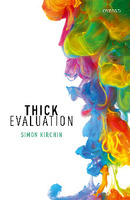
        Thick Evaluation

        Thumbnail
        Download PDF Viewer
        Web Shop
        Author(s)
        Kirchin, Simon
        Language
        English
        Show full item record
        Abstract
        "We use evaluative terms and concepts every day. We call actions right and wrong, teachers wise and ignorant, and pictures elegant and grotesque. Philosophers place evaluative concepts into two camps. Thin concepts, such as goodness and badness, and rightness and wrongness have evaluative content, but they supposedly have no or hardly any nonevaluative, descriptive content: they supposedly give little or no specific idea about the character of the person or thing described. In contrast, thick concepts such as kindness, elegance and wisdom supposedly give a more specific idea of people or things. Yet, given typical linguistic conventions, thick concepts also convey evaluation. Kind people are often viewed positively whilst ignorance has negative connotations. The distinction between thin and thick concepts is frequently drawn in philosophy and is central to everyday life. However, very few articles or books discuss the distinction. In this full-length study, Simon Kirchin discusses thin and thick concepts, highlighting key assumptions, questions and arguments, many of which have gone unnoticed. Kirchin focuses in on the debate between 'separationists' (those who think that thick concepts can be separated into component parts of evaluative, often very 'thin', content and nonevaluative content) and 'nonseparationists' (who deny this). Thick Evaluation argues for a version of nonseparationism, and in doing so argues both that many concepts are evaluative and also that evaluation is not exhausted by thin positive and negative stances."
        URI
        http://library.oapen.org/handle/20.500.12657/31028
        Keywords
        descriptive content; evaluation; ethics; thick concepts; thin concepts; aesthetics; Genus; Good and evil; Non-cognitivism; Semantics; Separation of church and state; Species
        DOI
        10.1093/oso/9780198803430.001.0001
        ISBN
        9780198803430
        OCN
        1011496942
        Publisher
        Oxford University Press
        Publisher website
        https://global.oup.com/
        Publication date and place
        2017
        Classification
        Philosophy of language
        Philosophy
        Philosophy: epistemology and theory of knowledge
        Ethics and moral philosophy
        Pages
        224
        Public remark
        Relevant Wikipedia pages: Ethics - https://en.wikipedia.org/wiki/Ethics; Genus - https://en.wikipedia.org/wiki/Genus; Good and evil - https://en.wikipedia.org/wiki/Good_and_evil; Non-cognitivism - https://en.wikipedia.org/wiki/Non-cognitivism; Semantics - https://en.wikipedia.org/wiki/Semantics; Separation of church and state - https://en.wikipedia.org/wiki/Separation_of_church_and_state; Species - https://en.wikipedia.org/wiki/Species
        Rights
        https://creativecommons.org/licenses/by-nc-nd/4.0/
        • Imported or submitted locally

        Browse

        All of OAPENSubjectsPublishersLanguagesCollections

        My Account

        LoginRegister

        Export

        Repository metadata
        Logo Oapen
        • For Librarians
        • For Publishers
        • For Researchers
        • Funders
        • Resources
        • OAPEN

        Newsletter

        • Subscribe to our newsletter
        • view our news archive

        Follow us on

        License

        • If not noted otherwise all contents are available under Attribution 4.0 International (CC BY 4.0)

        Credits

        • logo EU
        • This project received funding from the European Union's Horizon 2020 research and innovation programme under grant agreement No 683680, 810640, 871069 and 964352.

        OAPEN is based in the Netherlands, with its registered office in the National Library in The Hague.

        Director: Niels Stern

        Address:
        OAPEN Foundation
        Prins Willem-Alexanderhof 5
        2595 BE The Hague
        Postal address:
        OAPEN Foundation
        P.O. Box 90407
        2509 LK The Hague

        Websites:
        OAPEN Home: www.oapen.org
        OAPEN Library: library.oapen.org
        DOAB: www.doabooks.org


        Export search results

        The export option will allow you to export the current search results of the entered query to a file. Differen formats are available for download. To export the items, click on the button corresponding with the preferred download format.

        A logged-in user can export up to 15000 items. If you're not logged in, you can export no more than 500 items.

        To select a subset of the search results, click "Selective Export" button and make a selection of the items you want to export. The amount of items that can be exported at once is similarly restricted as the full export.

        After making a selection, click one of the export format buttons. The amount of items that will be exported is indicated in the bubble next to export format.