
Logo Oapen
  • Join
    • Deposit
    • For Librarians
    • For Publishers
    • For Researchers
    • Funders
    • Resources
    • OAPEN
        View Item 
        •   OAPEN Home
        • View Item
        •   OAPEN Home
        • View Item
        JavaScript is disabled for your browser. Some features of this site may not work without it.

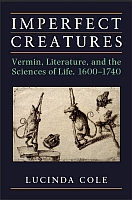
        Imperfect Creatures

        External Review of Whole Manuscript
        Thumbnail
        Download PDF Viewer
        Web Shop
        Author(s)
        Cole, Lucinda
        Collection
        Knowledge Unlatched (KU)
        Number
        103491
        Language
        English
        Show full item record
        Abstract
        "Lucinda Cole’s Imperfect Creatures offers the first full-length study of the shifting, unstable, but foundational status of “vermin” as creatures and category in the early modern literary, scientific, and political imagination. In the space between theology and an emergent empiricism, Cole’s argument engages a wide historical swath of canonical early modern literary texts—William Shakespeare’s Macbeth, Christopher Marlowe’s The Jew of Malta, Abraham Cowley’s The Plagues of Egypt, Thomas Shadwell’s The Virtuoso, the Earl of Rochester’s “A Ramble in St. James’s Park,” and Daniel Defoe’s Robinson Crusoe and Journal of the Plague Year—alongside other nonliterary primary sources and under-examined archival materials from the period, including treatises on animal trials, grain shortages, rabies, and comparative neuroanatomy. As Cole illustrates, human health and demographic problems—notably those of feeding populations periodically stricken by hunger, disease, and famine—were tied to larger questions about food supplies, property laws, national identity, and the theological imperatives that underwrote humankind’s claim to dominion over the animal kingdom. In this context, Cole’s study indicates, so-called “vermin” occupied liminal spaces between subject and object, nature and animal, animal and the devil, the devil and disease—even reason and madness. This verminous discourse formed a foundational category used to carve out humankind’s relationship to an unpredictable, irrational natural world, but it evolved into a form for thinking about not merely animals but anything that threatened the health of the body politic—humans, animals, and even thoughts."
        URI
        http://library.oapen.org/handle/20.500.12657/32703
        https://library.oapen.org/handle/20.500.12657/37514
        Keywords
        literature; nature; animals
        DOI
        10.3998/mpub.4424519
        ISBN
        9780472121557, 9780472072958, 9780472052950
        Publisher
        University of Michigan Press
        Publisher website
        https://www.press.umich.edu/
        Publication date and place
        Ann Arbor, 2016
        Grantor
        • Knowledge Unlatched
        Classification
        Literary studies: general
        Pages
        240
        Rights
        https://creativecommons.org/licenses/by-nc-nd/4.0/
        • Imported or submitted locally

        Browse

        All of OAPENSubjectsPublishersLanguagesCollections

        My Account

        LoginRegister

        Export

        Repository metadata
        Logo Oapen
        • For Librarians
        • For Publishers
        • For Researchers
        • Funders
        • Resources
        • OAPEN

        Newsletter

        • Subscribe to our newsletter
        • view our news archive

        Follow us on

        License

        • If not noted otherwise all contents are available under Attribution 4.0 International (CC BY 4.0)

        Credits

        • logo EU
        • This project received funding from the European Union's Horizon 2020 research and innovation programme under grant agreement No 683680, 810640, 871069 and 964352.

        OAPEN is based in the Netherlands, with its registered office in the National Library in The Hague.

        Director: Niels Stern

        Address:
        OAPEN Foundation
        Prins Willem-Alexanderhof 5
        2595 BE The Hague
        Postal address:
        OAPEN Foundation
        P.O. Box 90407
        2509 LK The Hague

        Websites:
        OAPEN Home: www.oapen.org
        OAPEN Library: library.oapen.org
        DOAB: www.doabooks.org


        Export search results

        The export option will allow you to export the current search results of the entered query to a file. Differen formats are available for download. To export the items, click on the button corresponding with the preferred download format.

        A logged-in user can export up to 15000 items. If you're not logged in, you can export no more than 500 items.

        To select a subset of the search results, click "Selective Export" button and make a selection of the items you want to export. The amount of items that can be exported at once is similarly restricted as the full export.

        After making a selection, click one of the export format buttons. The amount of items that will be exported is indicated in the bubble next to export format.