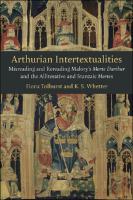
Arthurian Intertextualities
Misreading and Rereading Malory's Morte Darthur and the Alliterative and Stanzaic Mortes
| dc.contributor.author | Tolhurst, Fiona | |
| dc.contributor.author | Whetter, K.S. | |
| dc.date.accessioned | 2025-09-12T12:23:11Z | |
| dc.date.available | 2025-09-12T12:23:11Z | |
| dc.date.issued | 2025 | |
| dc.identifier | ONIX_20250912T141556_9780472905263_6 | |
| dc.identifier.uri | https://library.oapen.org/handle/20.500.12657/105970 | |
| dc.description.abstract | Readers encountering the Middle English Arthurian tradition are confronted by three texts with confusingly similar titles: an anonymous poem in alliterative verse called Morte Arthure, an anonymous poem in eight-line stanzas entitled Le Morte Arthur, and Sir Thomas Malory’s influential prose Arthuriad, LeMorte Darthur [sic]. To add to the confusion, Malory made use of both English poems to augment his French sources in composing his Morte Darthur, so specialists often speak of two or more of these English Mortes in the same breath. Yet each Morte poem deserves to be studied on its own merits. Arthurian Intertextualities offers new readings of Malory’s Morte as well as the two English poems that most influenced him. Tolhurst and Whetter situate Malory’s Arthur story in the context of fourteenth- and fifteenth-century England. Combining these contexts with intertextual analysis of scenes and characters from Le Morte Darthur and both sources, the authors illustrate the full extent of Malory’s debt to these two English poems while making a stronger case for Malory’s artistry—and the stanzaic-poet’s artistry—than previous scholarship has acknowledged. These new readings demand a reassessment of Arthurian women, kingship, and warfare and heroism, including reconsidering the alliterative-poet’s attitude to war and to Arthur as conqueror. The authors also offer a spirited defense of Malory’s Guenevere, who remains frequently maligned by scholars, and argue for Palomydes’s acceptance by his Round Table Fellowship. Arthurian Intertextualities will appeal to readers who are interested in the book that serves as the source for most of the Arthuriana (whether novels, plays, works of art, or films) in today’s world: Le Morte Darthur. | |
| dc.language | English | |
| dc.subject.classification | thema EDItEUR::D Biography, Literature and Literary studies::DN Biography and non-fiction prose::DNT Anthologies: general | |
| dc.subject.classification | thema EDItEUR::D Biography, Literature and Literary studies::DB Ancient, classical and medieval texts | |
| dc.subject.classification | thema EDItEUR::D Biography, Literature and Literary studies::DS Literature: history and criticism::DSB Literary studies: general::DSBB Literary studies: ancient, classical and medieval | |
| dc.subject.other | Thomas Malory, Le Morte Darthur, La Morte d’Arthur, Le Morte Arthur, Morte Arthure, stanzaic Morte, alliterative Morte, Palomydes, Palomides, Saracens, Gwenyvere, Guenevere, Guinevere, Guinievre, Gaynour, Waynour, Launcelot, Lancelot, Elaine, Elayne, the Fair Maid of Ascolat, Ascolat, Ascalot, Astolat, Astalot, King Arthur, King Arthure, medieval warfare, intertextuality, comparative study, Arthurian literature, Arthurian heroism, Arthurian women, Trystram, Tristram, Gawayne, Wawayne, Gawain, Gauvain, Isode, Isolde, Yseult | |
| dc.title | Arthurian Intertextualities | |
| dc.title.alternative | Misreading and Rereading Malory's Morte Darthur and the Alliterative and Stanzaic Mortes | |
| dc.type | book | |
| oapen.identifier.doi | 10.3998/mpub.12306435 | |
| oapen.relation.isPublishedBy | e07ce9b5-7a46-4096-8f0c-bc1920e3d889 | |
| oapen.relation.isbn | 9780472905263 | |
| oapen.relation.isbn | 9780472133628 | |
| oapen.pages | 326 |