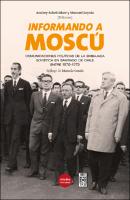
Informando a Moscú. Comunicaciones políticas de la Embajada Soviética en Santiago de Chile entre 1970-1973
| dc.contributor.editor | Schelchkov, Andrey | |
| dc.contributor.editor | Loyola, Manuel | |
| dc.date.accessioned | 2025-09-17T13:07:12Z | |
| dc.date.available | 2025-09-17T13:07:12Z | |
| dc.date.issued | 2025 | |
| dc.identifier | ONIX_20250917T150322_9789566276494_2 | |
| dc.identifier.uri | https://library.oapen.org/handle/20.500.12657/106020 | |
| dc.language | Spanish | |
| dc.subject.classification | thema EDItEUR::N History and Archaeology::NH History::NHT History: specific events and topics | |
| dc.subject.other | Chile, Soviet Union | |
| dc.subject.other | Government of Popular Unity | |
| dc.subject.other | Communications | |
| dc.title | Informando a Moscú. Comunicaciones políticas de la Embajada Soviética en Santiago de Chile entre 1970-1973 | |
| dc.type | book | |
| oapen.abstract.otherlanguage | The documents gathered here address concerns stemming from the extensive field of studies on the history of Popular Unity, the transnational history of Chilean politics, and the history of the Latin American Cold War. Each field has its own framework, and the documents can be read from these perspectives, with divergent ends. Fascinating traces of the past emerge from conversations such as the one Luis Corvalán held with the Soviet ambassador on August 8, 1973 (document 126), in the midst of an acute political, social, and economic crisis. Corvalán, there, accuses the Secretary General of the Socialist Party, Carlos Altamirano, of having proposed a "self-coup" as a solution to the current political dilemma, something completely ruled out by his communist allies, as well as by Allende himself. Corvalán, in fact, feared for the unity of his allies given the possibility of a split with the president given the magnitude of their differences. The conversation with the Soviet ambassador means different things, depending on the questions: it describes the desperate situation of the last days of Chilean democracy, the contradictions that this situation had exacerbated within the Unidad Popular, the relationships of trust between the general secretary of the Communist Party and the Soviet ambassador, and finally, the set of circumstances that led to the most relevant Chilean event with the greatest global impact of the 20th century: the coup that would destroy Chilean democracy and socialism and install that brutal dictatorship that, without time having completely blurred, is still present in today's Chile (from the prologue by Marcelo Casals). | |
| oapen.identifier.doi | 10.26448/ae9789566276494.127 | |
| oapen.relation.isPublishedBy | f6cb5ffd-d9ed-409f-b6f8-71eb0272e363 | |
| oapen.relation.isbn | 9789566276494 | |
| oapen.pages | 662 | |
| oapen.place.publication | Santiago, Chile |