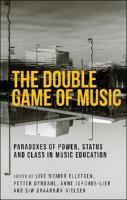
The double game of music
Paradoxes of power, status and class in music education
| dc.contributor.author | Dyndahl, Petter | |
| dc.contributor.author | Ellefsen, Live Weider | |
| dc.contributor.author | Jordhus-Lier, Anne | |
| dc.contributor.author | Graabræk Nielsen, Siw | |
| dc.contributor.author | Manum, Kari Marie | |
| dc.contributor.author | Karlsen, Sidsel | |
| dc.contributor.author | Lunde, Ingeborg | |
| dc.contributor.author | Skårberg, Odd | |
| dc.contributor.author | Merkelbach, Friederike | |
| dc.contributor.editor | Ellefsen, Live Weider | |
| dc.contributor.editor | Dyndahl, Petter | |
| dc.contributor.editor | Jordhus-Lier, Anne | |
| dc.contributor.editor | Nielsen, Siw Graabræk | |
| dc.date.accessioned | 2026-02-17T12:36:18Z | |
| dc.date.available | 2026-02-17T12:36:18Z | |
| dc.date.issued | 2025 | |
| dc.identifier.uri | https://library.oapen.org/handle/20.500.12657/109990 | |
| dc.description.abstract | The double game of music offers a critical analysis of the complex social dynamics of music education at a time when the power of music to promote inclusion and democratisation is often taken for granted. Inspired by Bourdieu, Foucault, Huizinga and other theorists who have explored the analytical potential of the ‘game’ as a metaphor for social interaction, the book employs the game metaphor to investigate the intricate interplay of social relations in various contexts of musical upbringing. These contexts include parenting, children’s play, leisure activities, talent education, schooling, academia and the music and television industries. Throughout the book, the Norwegian welfare state model of education serves as a salient case to expose the misrecognised and even hidden power dynamics within systems designed to promote equality and social mobility. By examining players’ belief in the games they play, the intertwinement of material and symbolic economies and the relations of specific educational games to the broader field of social power, the authors unravel the mechanisms of power, status and class that determine who gets to play the games of music education, and how. With its rich theoretical insights and nuanced analysis, grounded in empirical examples and drawing extensively on international contributions, The double game of music contributes with a timely reminder that music matters in complex, often contradictory ways. It is not just a book about the social regulation of music education; it’s about the pivotal role music education plays in the ongoing struggle for social justice, equity and cultural understanding. | |
| dc.language | English | |
| dc.relation.ispartofseries | Music and Society | |
| dc.subject.classification | thema EDItEUR::Y Children’s, Teenage and Educational::YP Educational material::YPA Educational: Arts, general::YPAD Educational: Music | |
| dc.subject.classification | thema EDItEUR::J Society and Social Sciences::JN Education::JND Educational systems and structures | |
| dc.subject.classification | thema EDItEUR::1 Place qualifiers::1D Europe::1DN Northern Europe, Scandinavia::1DNN Norway | |
| dc.subject.classification | thema EDItEUR::A The Arts::AV Music::AVA Theory of music and musicology | |
| dc.subject.classification | thema EDItEUR::J Society and Social Sciences::JN Education::JNA Philosophy and theory of education | |
| dc.subject.classification | thema EDItEUR::J Society and Social Sciences::JN Education::JND Educational systems and structures::JNDG Curriculum planning and development | |
| dc.subject.classification | thema EDItEUR::J Society and Social Sciences::JB Society and culture: general::JBS Social groups, communities and identities::JBSA Social classes | |
| dc.subject.classification | thema EDItEUR::J Society and Social Sciences::JN Education::JNF Educational strategies and policy | |
| dc.subject.other | Music education | |
| dc.subject.other | Sociology of music education | |
| dc.subject.other | Double game | |
| dc.subject.other | Social class | |
| dc.subject.other | The welfare state | |
| dc.subject.other | Musical talent | |
| dc.subject.other | Parenting | |
| dc.subject.other | Musical gentrification | |
| dc.subject.other | Children’s play | |
| dc.subject.other | Genre and 'genring' | |
| dc.subject.other | Music education concepts | |
| dc.subject.other | Conflict-oriented sociology | |
| dc.subject.other | Poststructuralism | |
| dc.subject.other | Structure and content of the book. | |
| dc.subject.other | Play | |
| dc.subject.other | Social dynamics | |
| dc.subject.other | Structural inequality | |
| dc.subject.other | Educational investment | |
| dc.subject.other | Symbolic capital | |
| dc.subject.other | Bourdieuian and post-Bourdieuian theory | |
| dc.subject.other | Power | |
| dc.subject.other | Democracy | |
| dc.subject.other | Inclusion | |
| dc.subject.other | Norwegian welfare state | |
| dc.subject.other | Cultural reproduction | |
| dc.subject.other | School music education | |
| dc.subject.other | Music and art school education | |
| dc.subject.other | Genre and genring | |
| dc.subject.other | Gendering | |
| dc.subject.other | Genderfication | |
| dc.subject.other | Higher music education | |
| dc.subject.other | Piketty | |
| dc.subject.other | Classification | |
| dc.subject.other | Intersectionality | |
| dc.subject.other | Performativity | |
| dc.subject.other | Subjectivation | |
| dc.subject.other | Social distinction | |
| dc.subject.other | Musical parenting | |
| dc.subject.other | Intensive parenting | |
| dc.subject.other | Concerted cultivation | |
| dc.subject.other | Investment | |
| dc.subject.other | Cultural capital | |
| dc.subject.other | Habitus | |
| dc.subject.other | Musical upbringing. | |
| dc.subject.other | Children's play | |
| dc.subject.other | Day care education | |
| dc.subject.other | Childhood | |
| dc.subject.other | Childing | |
| dc.subject.other | Musical agency | |
| dc.subject.other | Social investment | |
| dc.subject.other | Social reproduction | |
| dc.subject.other | Public broadcasting | |
| dc.subject.other | Children’s television programmes | |
| dc.subject.other | Norwegian welfare state values | |
| dc.subject.other | ‘childity’. | |
| dc.subject.other | Talentification | |
| dc.subject.other | Authenticity | |
| dc.subject.other | Music industry | |
| dc.subject.other | Social media | |
| dc.subject.other | Indigeneity | |
| dc.subject.other | Ethnicity | |
| dc.subject.other | Race. | |
| dc.subject.other | Musical upbringing | |
| dc.subject.other | Material and symbolic economies | |
| dc.subject.other | Sociology | |
| dc.title | The double game of music | |
| dc.title.alternative | Paradoxes of power, status and class in music education | |
| dc.type | book | |
| oapen.identifier.doi | 10.7765/9781526187253 | |
| oapen.relation.isPublishedBy | 6110b9b4-ba84-42ad-a0d8-f8d877957cdd | |
| oapen.relation.isbn | 9781526187253 | |
| oapen.relation.isbn | 9781526187246 | |
| oapen.pages | 281 | |
| oapen.place.publication | Manchester |