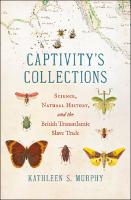
Captivity's Collections
Science, Natural History, and the British Transatlantic Slave Trade
| dc.contributor.author | Murphy, Kathleen S. | |
| dc.date.accessioned | 2026-02-18T15:35:26Z | |
| dc.date.available | 2026-02-18T15:35:26Z | |
| dc.date.issued | 2023 | |
| dc.identifier.uri | https://library.oapen.org/handle/20.500.12657/109998 | |
| dc.description.abstract | Cashews from Africa’s Gold Coast, butterflies from Sierra Leone, jalap root from Veracruz, shells from Jamaica—in the eighteenth century, these specimens from faraway corners of the Atlantic were tucked away onboard inhumane British slaving vessels. Kathleen S. Murphy argues that the era’s explosion of new natural knowledge was deeply connected to the circulation of individuals, objects, and ideas through the networks of the British transatlantic slave trade. Plants, seeds, preserved animals and insects, and other specimens were gathered by British slave ship surgeons, mariners, and traders at slaving factories in West Africa, in ports where captive Africans disembarked, and near the British South Sea Company’s trading factories in Spanish America. The specimens were displayed in British museums and herbaria, depicted in published natural histories, and discussed in the halls of scientific societies. Grounded in extensive archival research on both sides of the Atlantic, Captivity’s Collections mines scientific treatises, slaving companies' records, naturalists' correspondence, and museum catalogs to recover in rich detail the scope of the slave trade’s collecting operations. The book reveals the scientific and natural historical profit derived from these activities and the crucial role of specimens gathered along the routes of the slave trade on emerging ideas in natural history. | |
| dc.language | English | |
| dc.relation.ispartofseries | Flows, Migrations, and Exchanges | |
| dc.subject.classification | thema EDItEUR::N History and Archaeology::NH History::NHD European history | |
| dc.subject.classification | thema EDItEUR::N History and Archaeology::NH History::NHT History: specific events and topics::NHTS Slavery and abolition of slavery | |
| dc.subject.classification | thema EDItEUR::P Mathematics and Science::PS Biology, life sciences::PSA Life sciences: general issues::PSAF Ecological science, the Biosphere | |
| dc.subject.other | Eighteenth-century British slave trade | |
| dc.subject.other | Natural history | |
| dc.subject.other | History of science and medicine | |
| dc.subject.other | Early modern Atlantic World | |
| dc.subject.other | Atlantic slavery | |
| dc.subject.other | Legacies of slavery and the slave trade | |
| dc.subject.other | Natural historical collecting | |
| dc.subject.other | Atlantic History | |
| dc.subject.other | Slavery studies | |
| dc.subject.other | Collectors and collecting | |
| dc.subject.other | Museum studies | |
| dc.subject.other | Transatlantic slave trade | |
| dc.subject.other | Natural history museums | |
| dc.subject.other | British colonialism and science | |
| dc.subject.other | History of natural history and biological sciences | |
| dc.subject.other | History of collecting | |
| dc.subject.other | Maritime history | |
| dc.subject.other | Imperialism and colonialism | |
| dc.subject.other | Science and commerce | |
| dc.subject.other | Science and empire | |
| dc.subject.other | Natural knowledge production | |
| dc.subject.other | Enslaved collectors | |
| dc.subject.other | Scientific profits of the slave trade | |
| dc.subject.other | History of museums | |
| dc.subject.other | Colonial British America and the Caribbean | |
| dc.subject.other | West and West Central Africa | |
| dc.subject.other | Slave ship surgeons | |
| dc.subject.other | Slave ships | |
| dc.title | Captivity's Collections | |
| dc.title.alternative | Science, Natural History, and the British Transatlantic Slave Trade | |
| dc.type | book | |
| oapen.identifier.doi | 10.5149/9781469675930_Murphy | |
| oapen.relation.isPublishedBy | 165ebb72-a81f-4229-898c-5f49a35f306e | |
| oapen.relation.isbn | 9781469675930 | |
| oapen.relation.isbn | 9798890862891 | |
| oapen.relation.isbn | 9781469675923 | |
| oapen.relation.isbn | 9781469679709 | |
| oapen.imprint | The University of North Carolina Press | |
| oapen.pages | 256 | |
| oapen.place.publication | Chapel Hill |