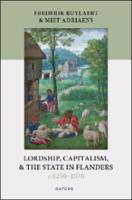
Lordship, Capitalism, and the State in Flanders (c. 1250–1570)
| dc.contributor.author | Buylaert and Miet Adriaens, Frederik | |
| dc.date.accessioned | 2026-03-02T17:52:19Z | |
| dc.date.available | 2026-03-02T17:52:19Z | |
| dc.date.issued | 2025 | |
| dc.identifier.uri | https://library.oapen.org/handle/20.500.12657/110809 | |
| dc.language | Multiple languages | |
| dc.subject.classification | thema EDItEUR::N History and Archaeology::NH History::NHD European history::NHDJ European history: medieval period, middle ages | |
| dc.subject.classification | thema EDItEUR::N History and Archaeology::NH History::NHD European history | |
| dc.subject.classification | thema EDItEUR::N History and Archaeology::NH History::NHT History: specific events and topics::NHTB Social and cultural history | |
| dc.subject.other | Lordship | |
| dc.subject.other | State formation | |
| dc.subject.other | Agrarian capitalism | |
| dc.subject.other | Low Countries | |
| dc.subject.other | Peasants | |
| dc.subject.other | Villages | |
| dc.subject.other | Elites | |
| dc.subject.other | Social inequality | |
| dc.title | Lordship, Capitalism, and the State in Flanders (c. 1250–1570) | |
| dc.type | book | |
| oapen.abstract.otherlanguage | This book engages with recent debates on lordship as a cornerstone of rural society in Europe. As a distinct outlier in the spectrum of possibilities, Flanders provides an extreme example of a scenario in which seigneuries were not so much vehicles for noble rulership as instruments for village communities to defend their interests. Imagining the Low Countries as a proto-bourgeois society, historians always assumed that local lordship was effectively crushed between strong cities and states, but in fact its importance for Flemish society was just as great and possibly greater at the start of the Dutch Revolt in 1567 than it was around the mid-thirteenth century, where this study begins. As both towns and princely administrations provided villagers with a shield against capricious lords, the seigneurie could only continue to function if it was closely aligned with the interests of peasants. The self-rule of Flemish peasantries through lordship meant that the seigneurie was the forum in which contemporaries made a critical decision, that being how to respond to the new and all-encompassing phenomenon of agrarian capitalism, a mode of agricultural production that first emerged in the Low Countries and Flanders before spreading to the rest of the globe. The birth of what we call ‘middle-class lordship’ helps scholars to understand how power relations between lords and peasants differed from one region to the next in dialogue with different trajectories in urbanization, economic change, and state formation. | |
| oapen.identifier.doi | 10.1093/9780198945758.001.0001 | |
| oapen.relation.isPublishedBy | b9501915-cdee-4f2a-8030-9c0b187854b2 | |
| oapen.relation.isbn | 9780198945727 | |
| oapen.relation.isbn | 9780198945758 | |
| oapen.relation.isbn | 9780198945741 | |
| oapen.relation.isbn | 9780198945734 | |
| oapen.imprint | Oxford Studies in Medieval European History | |
| oapen.pages | 368 | |
| oapen.place.publication | Oxford |