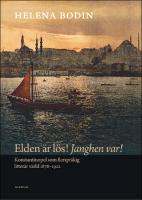
Elden är lös! Janghen var!
Konstantinopel som flerspråkig litterär värld 1878–1922
| dc.contributor.author | Bodin, Helena | |
| dc.date.accessioned | 2026-03-02T18:05:48Z | |
| dc.date.available | 2026-03-02T18:05:48Z | |
| dc.date.issued | 2025 | |
| dc.identifier.uri | https://library.oapen.org/handle/20.500.12657/111010 | |
| dc.language | Swedish | |
| dc.subject.classification | thema EDItEUR::D Biography, Literature and Literary studies::DS Literature: history and criticism::DSM Comparative literature | |
| dc.subject.classification | thema EDItEUR::C Language and Linguistics::CF Linguistics::CFD Psycholinguistics and cognitive linguistics::CFDM Bilingualism and multilingualism | |
| dc.subject.classification | thema EDItEUR::J Society and Social Sciences::JB Society and culture: general::JBC Cultural and media studies::JBCC Cultural studies | |
| dc.subject.classification | thema EDItEUR::C Language and Linguistics::CF Linguistics::CFL Palaeography::CFLA Writing systems, alphabets | |
| dc.subject.classification | thema EDItEUR::J Society and Social Sciences::JB Society and culture: general::JBS Social groups, communities and identities::JBSL Ethnic studies::JBSL1 Ethnic groups and multicultural studies | |
| dc.subject.other | Print culture | |
| dc.subject.other | Scriptworlds | |
| dc.subject.other | Travel writing | |
| dc.subject.other | Women authors | |
| dc.subject.other | Istanbul | |
| dc.subject.other | Literary multilingualism | |
| dc.title | Elden är lös! Janghen var! | |
| dc.title.alternative | Konstantinopel som flerspråkig litterär värld 1878–1922 | |
| dc.type | book | |
| oapen.abstract.otherlanguage | This monograph in Swedish examines how Constantinople (Istanbul) emerges as a multilingual literary world in fiction and travel writing between 1878 and 1922. Drawing on recent international research in literary multilingualism, world literature, and translation studies, Helena Bodin traces a multilingually imagined community. Thanks to the city’s rich print culture, reading becomes a meeting place between visitors and residents – a place that welcomes also contemporary readers. During the decades around 1900, Constantinople was a city marked by crises – fires, wars, revolutions, and waves of refugees and migrants. The study spans the protracted decline of the Ottoman Empire under Sultan Abdülhamid II to the rise of the Turkish Republic under Mustafa Kemal Atatürk, who carried through the Turkish language and alphabet reforms in 1928. Key issues addressed are exilic writing, the lives of women in harems, and literacy education. The material analysed includes novels, short stories, poems, travelogues, and collections of letters by around thirty authors, written in a dozen languages with five different scripts: Swedish, Danish, Norwegian, English, French, German, Italian, Croatian, Russian, Armenian, Modern Greek, and (Ottoman) Turkish. All of them render phrases in the many languages of Constantinople, and several of these works were widely translated. Particular emphasis is placed on Swedophone texts, highlighting a Swedish literary interest in the city. Across nine chapters, the study explores how a multilingual – and at times multiscript – literary world is constructed in relation to both the city and its diverse readerships. The analyses mobilize a range of interrelated conceptual frameworks, including world-making, soundscape, and scriptworld, Yuri Lotman’s semiosphere, Eric Hayot’s literary worlds, the autobiografiction of diplomats, and Mikhail Bakhtin’s chronotope. Reflecting the linguistic diversity of Constantinople, this literary world transcends traditional national literary boundaries and challenges a monolingual paradigm. | |
| oapen.identifier.doi | 10.22188/kriterium.70 | |
| oapen.relation.isPublishedBy | 7b034f4a-b816-4718-88ac-63b24c8e4b24 | |
| oapen.relation.isbn | 9789170615443 | |
| oapen.relation.isbn | 9789176555446 | |
| oapen.imprint | Kriterium | |
| oapen.pages | 343 | |
| oapen.place.publication | Göteborg, Stockholm |