
Logo Oapen
  • Join
    • Deposit
    • For Librarians
    • For Publishers
    • For Researchers
    • Funders
    • Resources
    • OAPEN
        View Item 
        •   OAPEN Home
        • View Item
        •   OAPEN Home
        • View Item
        JavaScript is disabled for your browser. Some features of this site may not work without it.

        Safety Cultures, Safety Models

        Taking Stock and Moving Forward
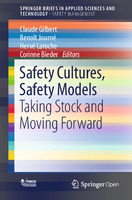
        Thumbnail
        Download PDF Viewer
        Web Shop
        Contributor(s)
        Gilbert, Claude (editor)
        Journé, Benoît (editor)
        Laroche, Hervé (editor)
        Bieder, Corinne (editor)
        Language
        English
        Show full item record
        Abstract
        The objective of this book is to help at-risk organizations to decipher the “safety cloud”, and to position themselves in terms of operational decisions and improvement strategies in safety, considering the path already travelled, their context, objectives and constraints. What link can be established between safety culture and safety models in order to increase safety within companies carrying out dangerous activities? First, while the term “safety culture” is widely shared among the academic and industrial world, it leads to various interpretations and therefore different positioning when it comes to assess, improve or change it. Many safety theories, concepts, and models coexist today, being more or less appealing and/or directly useful to the industry. How, and based on which criteria, to choose from the available options? These are some of the questions addressed in this book, which benefits from the expertise of its worldwide famous authors in several industrial sectors.
        URI
        http://library.oapen.org/handle/20.500.12657/23084
        Keywords
        Engineering; Quality control; Reliability; Industrial safety; Economic sociology; Industrial psychology; Industrial organization
        DOI
        10.1007/978-3-319-95129-4
        Publisher
        Springer Nature
        Publisher website
        https://www.springernature.com/gp/products/books
        Publication date and place
        Cham, 2018
        Series
        SpringerBriefs in Applied Sciences and Technology,
        Classification
        Sociology: work and labour
        Occupational and industrial psychology
        Economics of industrial organization
        Reliability engineering
        Pages
        166
        Rights
        https://creativecommons.org/licenses/by/4.0
        • Imported or submitted locally

        Browse

        All of OAPENSubjectsPublishersLanguagesCollections

        My Account

        LoginRegister

        Export

        Repository metadata
        Logo Oapen
        • For Librarians
        • For Publishers
        • For Researchers
        • Funders
        • Resources
        • OAPEN

        Newsletter

        • Subscribe to our newsletter
        • view our news archive

        Follow us on

        License

        • If not noted otherwise all contents are available under Attribution 4.0 International (CC BY 4.0)

        Credits

        • logo EU
        • This project received funding from the European Union's Horizon 2020 research and innovation programme under grant agreement No 683680, 810640, 871069 and 964352.

        OAPEN is based in the Netherlands, with its registered office in the National Library in The Hague.

        Director: Niels Stern

        Address:
        OAPEN Foundation
        Prins Willem-Alexanderhof 5
        2595 BE The Hague
        Postal address:
        OAPEN Foundation
        P.O. Box 90407
        2509 LK The Hague

        Websites:
        OAPEN Home: www.oapen.org
        OAPEN Library: library.oapen.org
        DOAB: www.doabooks.org


        Export search results

        The export option will allow you to export the current search results of the entered query to a file. Differen formats are available for download. To export the items, click on the button corresponding with the preferred download format.

        A logged-in user can export up to 15000 items. If you're not logged in, you can export no more than 500 items.

        To select a subset of the search results, click "Selective Export" button and make a selection of the items you want to export. The amount of items that can be exported at once is similarly restricted as the full export.

        After making a selection, click one of the export format buttons. The amount of items that will be exported is indicated in the bubble next to export format.