
Logo Oapen
  • Join
    • Deposit
    • For Librarians
    • For Publishers
    • For Researchers
    • Funders
    • Resources
    • OAPEN
        View Item 
        •   OAPEN Home
        • View Item
        •   OAPEN Home
        • View Item
        JavaScript is disabled for your browser. Some features of this site may not work without it.

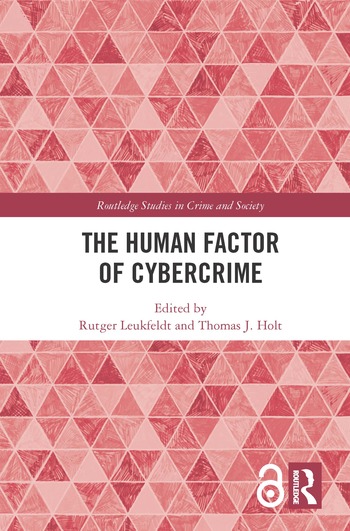
        The Human Factor of Cybercrime

        Proposal review
        Thumbnail
        Contributor(s)
        Leukfeldt, Rutger (editor)
        Holt, Thomas J. (editor)
        Language
        English
        Show full item record
        Abstract
        Cybercrimes are often viewed as technical offenses that require technical solutions, such as antivirus programs or automated intrusion detection tools. However, these crimes are committed by individuals or networks of people which prey upon human victims and are detected and prosecuted by criminal justice personnel. As a result, human decision-making plays a substantial role in the course of an offence, the justice response, and policymakers' attempts to legislate against these crimes. This book focuses on the human factor in cybercrime: its offenders, victims, and parties involved in tackling cybercrime. The distinct nature of cybercrime has consequences for the entire spectrum of crime and raises myriad questions about the nature of offending and victimization. For example, are cybercriminals the same as traditional offenders, or are there new offender types with distinct characteristics and motives? What foreground and situational characteristics influence the decision-making process of offenders? Which personal and situational characteristics provide an increased or decreased risk of cybercrime victimization? This book brings together leading criminologists from around the world to consider these questions and examine all facets of victimization, offending, offender networks, and policy responses.
        URI
        http://library.oapen.org/handle/20.500.12657/23615
        Keywords
        cybercrime; human factor
        ISBN
        9780429460593
        OCN
        1135846432
        Publisher
        Taylor & Francis
        Publisher website
        https://taylorandfrancis.com/
        Publication date and place
        2019
        Imprint
        Routledge
        Classification
        Crime and criminology
        Digital and information technologies: social and ethical aspects
        Human–computer interaction
        Pages
        432
        Chapters in this book
        • Chapter 13 The Roles of ‘Old’ and ‘New’ Media Tools and Technologies in the Facilitation of Violent Extremism and Terrorism
        Rights
        • Imported or submitted locally

        Browse

        All of OAPENSubjectsPublishersLanguagesCollections

        My Account

        LoginRegister

        Export

        Repository metadata
        Logo Oapen
        • For Librarians
        • For Publishers
        • For Researchers
        • Funders
        • Resources
        • OAPEN

        Newsletter

        • Subscribe to our newsletter
        • view our news archive

        Follow us on

        License

        • If not noted otherwise all contents are available under Attribution 4.0 International (CC BY 4.0)

        Credits

        • logo EU
        • This project received funding from the European Union's Horizon 2020 research and innovation programme under grant agreement No 683680, 810640, 871069 and 964352.

        OAPEN is based in the Netherlands, with its registered office in the National Library in The Hague.

        Director: Niels Stern

        Address:
        OAPEN Foundation
        Prins Willem-Alexanderhof 5
        2595 BE The Hague
        Postal address:
        OAPEN Foundation
        P.O. Box 90407
        2509 LK The Hague

        Websites:
        OAPEN Home: www.oapen.org
        OAPEN Library: library.oapen.org
        DOAB: www.doabooks.org


        Export search results

        The export option will allow you to export the current search results of the entered query to a file. Differen formats are available for download. To export the items, click on the button corresponding with the preferred download format.

        A logged-in user can export up to 15000 items. If you're not logged in, you can export no more than 500 items.

        To select a subset of the search results, click "Selective Export" button and make a selection of the items you want to export. The amount of items that can be exported at once is similarly restricted as the full export.

        After making a selection, click one of the export format buttons. The amount of items that will be exported is indicated in the bubble next to export format.