
Logo Oapen
  • Join
    • Deposit
    • For Librarians
    • For Publishers
    • For Researchers
    • Funders
    • Resources
    • OAPEN
        View Item 
        •   OAPEN Home
        • View Item
        •   OAPEN Home
        • View Item
        JavaScript is disabled for your browser. Some features of this site may not work without it.

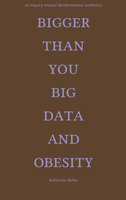
        Bigger Than You: Big Data and Obesity
        Thumbnail
        Download PDF Viewer
        Author(s)
        Behar, Katherine
        Collection
        ScholarLed
        Language
        English
        Show full item record
        Abstract
        In her first inquiry toward a decelerationist aesthetics, Katherine Behar explores in this essay chapbook the rise of two “big deal” contemporary phenomena, big data and obesity. In both, scale rearticulates the human as a diffuse informational pattern, causing important shifts in political form as well as aesthetic form. Bigness redraws relationships between the singular and the collective. Understood as informational patterns, collectives can be radically inclusive, even incorporating nonhumans. As a result, the political subject is slowly becoming a new object. This social and informational body belongs to no single individual, but is shared in solidarity with something “bigger than you.” In decelerationist aesthetics, the aesthetic properties, proclivities, and performances of objects come to defy the accelerationist imperative to be nimbly individuated. Decelerationist aesthetics rejects atomistic, liberal, humanist subjects; this unit of self is too consonant with capitalist relations and functions. Instead, decelerationist aesthetics favors transhuman sociality embodied in particulate, mattered objects; the aesthetic form of such objects resists capitalist speed and immediacy by taking back and taking up space and time. In just this way, big data calls into question the conventions by which humans are defined as discrete entities, and individual scales of agency are made to form central binding pillars of social existence through which bodies are drawn into relations of power and pathos
        URI
        http://library.oapen.org/handle/20.500.12657/25490
        Keywords
        big data; computing; cultural studies; obesity; technology
        DOI
        10.21983/P3.0135.1.00
        ISBN
        9780692652831
        OCN
        982244908
        Publisher
        punctum books
        Publisher website
        https://punctumbooks.com/
        Publication date and place
        Brooklyn, NY, 2016
        Classification
        Cultural studies
        Pages
        70
        Rights
        https://creativecommons.org/licenses/by-nc-sa/4.0/
        • Imported or submitted locally

        Browse

        All of OAPENSubjectsPublishersLanguagesCollections

        My Account

        LoginRegister

        Export

        Repository metadata
        Logo Oapen
        • For Librarians
        • For Publishers
        • For Researchers
        • Funders
        • Resources
        • OAPEN

        Newsletter

        • Subscribe to our newsletter
        • view our news archive

        Follow us on

        License

        • If not noted otherwise all contents are available under Attribution 4.0 International (CC BY 4.0)

        Credits

        • logo EU
        • This project received funding from the European Union's Horizon 2020 research and innovation programme under grant agreement No 683680, 810640, 871069 and 964352.

        OAPEN is based in the Netherlands, with its registered office in the National Library in The Hague.

        Director: Niels Stern

        Address:
        OAPEN Foundation
        Prins Willem-Alexanderhof 5
        2595 BE The Hague
        Postal address:
        OAPEN Foundation
        P.O. Box 90407
        2509 LK The Hague

        Websites:
        OAPEN Home: www.oapen.org
        OAPEN Library: library.oapen.org
        DOAB: www.doabooks.org


        Export search results

        The export option will allow you to export the current search results of the entered query to a file. Differen formats are available for download. To export the items, click on the button corresponding with the preferred download format.

        A logged-in user can export up to 15000 items. If you're not logged in, you can export no more than 500 items.

        To select a subset of the search results, click "Selective Export" button and make a selection of the items you want to export. The amount of items that can be exported at once is similarly restricted as the full export.

        After making a selection, click one of the export format buttons. The amount of items that will be exported is indicated in the bubble next to export format.