
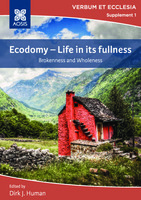
Ecodomy - Life in its fullness
 Download
 Web Shop
Contributor(s)
Human, Dirk J. (editor)
Language
EnglishAbstract
This book provides a coherent and conceptual portrayal of aspects of the theological research theme, entitled Ecodomy (literally meaning to ‘build a house’). In its figurative meaning the term Ecodomy addresses the theme, ‘life in its fullness’. This fullness of life entails a polarity which is inherently part of life, namely its brokenness and its wholeness. From various theological disciplines, namely Old Testament Studies, New Testament Studies, Systematic Theology, Church History and Practical Theology, both the brokenness and wholeness are addressed theologically. Every chapter focuses on a specific theological discipline, while the combination of theological disciplines, addresses the brokenness and wholeness of life as coherent concept. One pole does not exclude the other. Brokenness is visible in current or recent very relevant societal challenges, such as racism and xenophobia, apartheid, foreignness and exclusivism, leadership crises and violence. In contrast, wholeness is embedded in themes such as the African concept of ubuntu, a life of faith and wisdom, reconciling leadership, or transforming space and community. Ultimately, a Greek term ἀναίδεια (persistence) is connected to the meaning of Ecodomy and ‘life in its fullness’. Several methodologies have been used in the different contributions of the book. Every theological discipline applies a different methodology for the purpose of exposing a specific topic or research theme. In general, the contributions in this book follow a combination of a literature study with the further application of diachronic and synchronic exegetical methods. In addition, single contributions follow an own hermeneutical approach. Not one single contribution, but a combination of different theological disciplines, which form the concepts of brokenness and wholeness (life in its fullness), which expose the polarity of life, are included in this book. In its exposed interdisciplinary interwovenness, the book provides a tapestry of how different theological disciplines are combined into a single theme and how they contribute together by means of theological analyses and attempted building blocks to build the broken ‘houses’ of societal structures or human life. The book contributes to selected aspects of broken life in society and the healing experiences of human life. Several themes touch on recent and relevant challenges which have contributed to the brokenness of life. Not only in South Africa, but globally these are currently relevant themes. They include realities of racism and xenophobia, apartheid, foreignness and exclusivism, leadership crises and violence. With the focus on wholeness, specific attention is given to the African concept of ubuntu, a life of faith and wisdom, reconciling leadership, and transforming space and society. A Greek term ἀναίδεια (insolence as ‘in keeping on asking’ – Lk 11:8) illuminates the theme of Ecodomy from the perspective of a parable. The target audience of the book is academic scholars and theologians, who specialise in the different fields of Theology, the Humanities and other Social Sciences. Furthermore, the book is also accessible to scholars of other academic disciplines outside these disciplines. The book contains original research and contributions have not been plagiarised from publications elsewhere.
Keywords
desmond tutu; dietrich bonhoeffer; apartheid; beyers naudé; ubuntu; university of pretoria; yhwh; xenophobia; south africa; book of ruth; God in Christianity; RacismDOI
10.4102/aosis.2017.elf18ISBN
9781928396147OCN
1030817204Publisher
AOSISPublisher website
https://books.aosis.co.za/index.php/obPublication date and place
Durbanville, 2017Grantor
Imprint
AOSISSeries
Verbum et Ecclesia, Supplement 1Classification
Religion and beliefs