
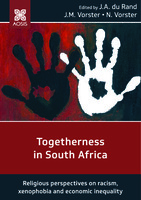
Togetherness in South Africa
Religious perspectives on racism, xenophobia and economic inequality
 Download
 Web Shop
Contributor(s)
Vorster, Jakobus (editor)
Du Rand, J.A. (editor)
Vorster, Nico (editor)
Language
EnglishAbstract
Race and inequality have always been sensitive topics in South African society due to its colonial past, diverse social composition and apartheid legacy of legal discrimination against people on the basis of their skin colour. Racial tensions seem to be escalating in South African society and disturbing racialised rhetoric and slogans are re-entering the political and social landscape. Another disturbing phenomenon has been violent incidents of xenophobia against African immigrants. The question probed by this book is: What perspectives can theology offer in addressing the roots of racism, inequality and xenophobia in South Africa and how can it and the church contribute to reconciliation and a sense of togetherness among South African citizens? Various methodologies and approaches are used to address this question. In chapter 1, Theuns Eloff employs a historical and socio-analytical approach to describe the social context that has given rise, and is still giving impetus to racism and other forms of intolerance in South African society. Nico Vorster approaches the issue of distorted racial identity constructions from a theological-anthropological perspective. Utilising various empirical studies, he attempts to provide conceptual clarity to the concepts of racism, nationalism, ethnocentrism and xenophobia, and maps the various racisms that we find in South Africa. His contribution concludes with a theological-anthropological discussion on ways in which theology can deconstruct distorted identities and contribute to the development of authentic identities. Koos Vorster provides a theological-ethical perspective on social stratification in South Africa. He identifies the patterns inherent to the institutionalisation of racist social structures and argues that many of these patterns are still present, albeit in a new disguise, in the South African social order. Jan du Rand provides in chapter 4 a semantic discussion of the notions of race and xenophobia. He argues that racist ideologies are not constructed on a factual basis, but that racial ideologies use semantic notions to construct social myths that enable them to attain power and justify the exploitation and oppression of the other. Du Rand’s second contribution in chapter 5 provides Reformed exegetical and hermeneutic perspectives on various passages and themes in the Bible that relate to anthropology, xenophobia and the imperative to xenophilia [love of the stranger]. Dirk Van der Merwe’s contribution analyses, evaluates, and compares both contemporary literature and ancient texts of the Bible to develop a model that can enable churches to promote reconciliation in society, while Ferdi Kruger investigates the various ways in which language can be used as a tool to disseminate hate speech. He offers an analytical description of hate language, provides normative perspectives on the duty to counter hate speech through truth speaking and phronesis (wisdom) and concludes with practical-theological perspectives that might enable us to address problematic praxis. Reggie Nel explores the Confessions of Belhar and the Declaration of Accra as theological lenses to provide markers for public witness in a postcolonial South African setting. The volume concludes with Riaan Rheeder’s Christian bioethical perspective on inequality in the health sector of sub-Sahara Africa. This book contains original research. No part was plagiarised or published elsewhere. The target audience are theologians, ministers and the Christian community, but social activists, social scientists, politicians, political theorists, sociologists and psychologists might also find the book applicable to their fields.
Keywords
human; white; apartheid; racial; christian; life; god; social; africa; racism; people; black; fights; economic; equality; church; hate; xenophobia; racist; context; global; identity; South Africa; White peopleDOI
10.4102/aosis.2017.tsa49ISBN
9781928396239OCN
1013871885Publisher
AOSISPublisher website
https://books.aosis.co.za/index.php/obPublication date and place
Durbanville, 2017Imprint
AOSISClassification
Religion and beliefs