
Logo Oapen
  • Join
    • Deposit
    • For Librarians
    • For Publishers
    • For Researchers
    • Funders
    • Resources
    • OAPEN
        View Item 
        •   OAPEN Home
        • View Item
        •   OAPEN Home
        • View Item
        JavaScript is disabled for your browser. Some features of this site may not work without it.

        Language of the Snakes

        Prakrit, Sanskrit, and the Language Order of Premodern India
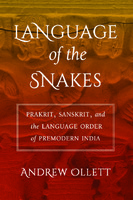
        Thumbnail
        Download PDF Viewer
        Web Shop
        Author(s)
        Ollett, Andrew
        Collection
        Knowledge Unlatched (KU); Luminos
        Language
        English
        Show full item record
        Abstract
        Language of the Snakes traces the history of the Prakrit language as a literary phenomenon, starting from its cultivation in courts of the Deccan in the first centuries of the common era. Although little studied today, Prakrit was an important vector of the kāvya movement and once joined Sanskrit at the apex of classical Indian literary culture. The opposition between Prakrit and Sanskrit was at the center of an enduring “language order” in India, a set of ways of thinking about, naming, classifying, representing, and ultimately using languages. As a language of classical literature that nevertheless retained its associations with more demotic language practices, Prakrit both embodies major cultural tensions—between high and low, transregional and regional, cosmopolitan and vernacular—and provides a unique perspective onto the history of literature and culture in South Asia.
        URI
        http://library.oapen.org/handle/20.500.12657/31094
        Keywords
        prakrit; sanskrit; literary history; indian languages; indian literature; Jainism; Satavahana dynasty
        DOI
        10.1525/luminos.37
        ISBN
        9780520968813
        OCN
        984512218
        Publisher
        University of California Press
        Publisher website
        https://www.ucpress.edu/
        Publication date and place
        Oakland, California, 2017
        Classification
        History
        Asian history
        Pages
        324
        Public remark
        Relevant Wikipedia pages: Jainism - https://en.wikipedia.org/wiki/Jainism; Prakrit - https://en.wikipedia.org/wiki/Prakrit; Sanskrit - https://en.wikipedia.org/wiki/Sanskrit; Satavahana dynasty - https://en.wikipedia.org/wiki/Satavahana_dynasty
        Rights
        https://creativecommons.org/licenses/by-nc-nd/4.0/
        • Imported or submitted locally

        Browse

        All of OAPENSubjectsPublishersLanguagesCollections

        My Account

        LoginRegister

        Export

        Repository metadata
        Logo Oapen
        • For Librarians
        • For Publishers
        • For Researchers
        • Funders
        • Resources
        • OAPEN

        Newsletter

        • Subscribe to our newsletter
        • view our news archive

        Follow us on

        License

        • If not noted otherwise all contents are available under Attribution 4.0 International (CC BY 4.0)

        Credits

        • logo EU
        • This project received funding from the European Union's Horizon 2020 research and innovation programme under grant agreement No 683680, 810640, 871069 and 964352.

        OAPEN is based in the Netherlands, with its registered office in the National Library in The Hague.

        Director: Niels Stern

        Address:
        OAPEN Foundation
        Prins Willem-Alexanderhof 5
        2595 BE The Hague
        Postal address:
        OAPEN Foundation
        P.O. Box 90407
        2509 LK The Hague

        Websites:
        OAPEN Home: www.oapen.org
        OAPEN Library: library.oapen.org
        DOAB: www.doabooks.org


        Export search results

        The export option will allow you to export the current search results of the entered query to a file. Differen formats are available for download. To export the items, click on the button corresponding with the preferred download format.

        A logged-in user can export up to 15000 items. If you're not logged in, you can export no more than 500 items.

        To select a subset of the search results, click "Selective Export" button and make a selection of the items you want to export. The amount of items that can be exported at once is similarly restricted as the full export.

        After making a selection, click one of the export format buttons. The amount of items that will be exported is indicated in the bubble next to export format.