Logo Oapen
  • Join
    • Deposit
    • For Librarians
    • For Publishers
    • For Researchers
    • Funders
    • Resources
    • OAPEN
        View Item 
        •   OAPEN Home
        • View Item
        •   OAPEN Home
        • View Item
        JavaScript is disabled for your browser. Some features of this site may not work without it.

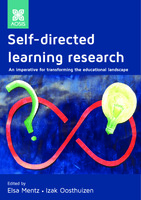
        Self-directed learning research: An imperative for transforming the educational landscape
        Thumbnail
        Download PDF Viewer
        Web Shop
        Author(s)
        Oosthuizen, Izak
        Contributor(s)
        Mentz, Elsa (editor)
        Language
        English
        Show full item record
        Abstract
        This book will benefit specialists in the field of the education sciences. It represents significant progress in knowledge production. Self-directed learning has become increasingly important, not only for education in South Africa but also for education sciences in the international arena. This is a result of the changing education landscape, caused by the demands of the 21st century as well as the rapid change in knowledge production. Learners should be equipped with skills to take responsibility for their own learning. New innovative strategies should be incorporated into teaching and learning in order to meet the changing demands in education. Traditional teacher-centred practices are still the norm in most South African schools and higher-education institutions and do not adequately prepare students for lifelong learning in the 21st century. The content focuses on the theory behind self-directed learning, explores strategies such as cooperative learning, problembased learning, case-based teaching and large-group teaching that enhance self-directed learning and the use of blended learning in a self-directed learning environment. The book demonstrates how self-directed learning can be enhanced in mathematics, computer-science and life-science education and through the use of student tutors for geography. Digital technology could, for example, also be used in innovative ways for education in isiZulu folk poetry. The findings are based on original empirical research and a sound theoretical-conceptual framework. In an environment of rapidly changing knowledge production, this book responds to the challenge of how to equip learners with the necessary skills to take responsibility for their own learning. The book presents innovative teaching and learning strategies for meeting the changing demands in education. Group activities, the responsibilities of learners and the obstacles that hinder their learning are analysed, and the way in which educators can support them is discussed. Educational values such as mutual trust are discussed, and self-directed assessment is explored. This is a timely collective work authored by experts who subscribe to the approach of self-directed learning. Educators should discover new teaching and learning strategies and value the integration of self-directed learning in the classroom.
        URI
        http://library.oapen.org/handle/20.500.12657/31807
        Keywords
        large-group teaching; cooperative learning; problem-based learning; academic writing; case-based teaching; blended learning; self-directed learning; Autodidacticism; Autonomy; Mathematics; South Africa; Zulu language
        DOI
        10.4102/aosis.sdlr.2016.03
        ISBN
        9781928396017
        OCN
        981904004
        Publisher
        AOSIS
        Publisher website
        https://books.aosis.co.za/index.php/ob
        Publication date and place
        Durbanville, 2016
        Grantor
        • North-West University
        Imprint
        AOSIS
        Classification
        Adult education, continuous learning
        Pages
        332
        Public remark
        Relevant Wikipedia pages: Academic writing - https://en.wikipedia.org/wiki/Academic_writing; Autodidacticism - https://en.wikipedia.org/wiki/Autodidacticism; Autonomy - https://en.wikipedia.org/wiki/Autonomy; Blended learning - https://en.wikipedia.org/wiki/Blended_learning; Mathematics - https://en.wikipedia.org/wiki/Mathematics; Problem-based learning - https://en.wikipedia.org/wiki/Problem-based_learning; South Africa - https://en.wikipedia.org/wiki/South_Africa; Zulu language - https://en.wikipedia.org/wiki/Zulu_language
        Rights
        https://creativecommons.org/licences/by-nc-sa/4.0/
        • Imported or submitted locally

        Browse

        All of OAPENSubjectsPublishersLanguagesCollections

        My Account

        LoginRegister

        Export

        Repository metadata
        Logo Oapen
        • For Librarians
        • For Publishers
        • For Researchers
        • Funders
        • Resources
        • OAPEN

        Newsletter

        • Subscribe to our newsletter
        • view our news archive

        Follow us on

        License

        • If not noted otherwise all contents are available under Attribution 4.0 International (CC BY 4.0)

        Credits

        • logo EU
        • This project received funding from the European Union's Horizon 2020 research and innovation programme under grant agreement No 683680, 810640, 871069 and 964352.

        OAPEN is based in the Netherlands, with its registered office in the National Library in The Hague.

        Director: Niels Stern

        Address:
        OAPEN Foundation
        Prins Willem-Alexanderhof 5
        2595 BE The Hague
        Postal address:
        OAPEN Foundation
        P.O. Box 90407
        2509 LK The Hague

        Websites:
        OAPEN Home: www.oapen.org
        OAPEN Library: library.oapen.org
        DOAB: www.doabooks.org


        Export search results

        The export option will allow you to export the current search results of the entered query to a file. Differen formats are available for download. To export the items, click on the button corresponding with the preferred download format.

        A logged-in user can export up to 15000 items. If you're not logged in, you can export no more than 500 items.

        To select a subset of the search results, click "Selective Export" button and make a selection of the items you want to export. The amount of items that can be exported at once is similarly restricted as the full export.

        After making a selection, click one of the export format buttons. The amount of items that will be exported is indicated in the bubble next to export format.