
Logo Oapen
  • Join
    • Deposit
    • For Librarians
    • For Publishers
    • For Researchers
    • Funders
    • Resources
    • OAPEN
        View Item 
        •   OAPEN Home
        • View Item
        •   OAPEN Home
        • View Item
        JavaScript is disabled for your browser. Some features of this site may not work without it.

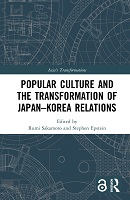
        Popular Culture and the Transformation of Japan–Korea Relations

        Proposal review
        Thumbnail
        Contributor(s)
        Sakamoto, Rumi (editor)
        Epstein, Stephen (editor)
        Language
        English
        Show full item record
        Abstract
        "This book presents essays exploring the ways in which popular culture reflects and engenders ongoing changes in Japan–Korea relations. Through a broad temporal coverage from the colonial period to the contemporary, the book’s chapters analyse the often contradictory roles that popular culture has played in either promoting or impeding nationalisms, regional conflict and reconciliations between Japan and Korea. Its contributors link several key areas of interest in East Asian Studies, including conflicts over historical memories and cultural production, grassroot challenges to state ideology, and the consequences of digital technology in Japan and South Korea. Taking recent discourse on Japan and South Korea as popular cultural superpowers further, this book expands its focus from mainstream entertainment media to the lived experience of daily life, in which sentiments and perceptions of the ‘popular’ are formed. It will be useful to students and scholars of Japanese and Korean studies, as well as film studies, media studies and cultural studies more widely."
        URI
        http://library.oapen.org/handle/20.500.12657/39527
        Keywords
        social science; popular culture; regional studies
        ISBN
        9780429399558
        Publisher
        Taylor & Francis
        Publisher website
        https://taylorandfrancis.com/
        Publication date and place
        2020
        Imprint
        Routledge
        Classification
        Society and culture: general
        Popular culture
        Chapters in this book
        • Chapter 3 The “Shiba view of history” and Japan–Korea relations
        Public remark
        Funder acronym: International comparative research into historical understanding and the consumption of war within contents tourism/ grant number 19H04377
        Rights
        • Imported or submitted locally

        Browse

        All of OAPENSubjectsPublishersLanguagesCollections

        My Account

        LoginRegister

        Export

        Repository metadata
        Logo Oapen
        • For Librarians
        • For Publishers
        • For Researchers
        • Funders
        • Resources
        • OAPEN

        Newsletter

        • Subscribe to our newsletter
        • view our news archive

        Follow us on

        License

        • If not noted otherwise all contents are available under Attribution 4.0 International (CC BY 4.0)

        Credits

        • logo EU
        • This project received funding from the European Union's Horizon 2020 research and innovation programme under grant agreement No 683680, 810640, 871069 and 964352.

        OAPEN is based in the Netherlands, with its registered office in the National Library in The Hague.

        Director: Niels Stern

        Address:
        OAPEN Foundation
        Prins Willem-Alexanderhof 5
        2595 BE The Hague
        Postal address:
        OAPEN Foundation
        P.O. Box 90407
        2509 LK The Hague

        Websites:
        OAPEN Home: www.oapen.org
        OAPEN Library: library.oapen.org
        DOAB: www.doabooks.org


        Export search results

        The export option will allow you to export the current search results of the entered query to a file. Differen formats are available for download. To export the items, click on the button corresponding with the preferred download format.

        A logged-in user can export up to 15000 items. If you're not logged in, you can export no more than 500 items.

        To select a subset of the search results, click "Selective Export" button and make a selection of the items you want to export. The amount of items that can be exported at once is similarly restricted as the full export.

        After making a selection, click one of the export format buttons. The amount of items that will be exported is indicated in the bubble next to export format.