
Logo Oapen
  • Join
    • Deposit
    • For Librarians
    • For Publishers
    • For Researchers
    • Funders
    • Resources
    • OAPEN
        View Item 
        •   OAPEN Home
        • View Item
        •   OAPEN Home
        • View Item
        JavaScript is disabled for your browser. Some features of this site may not work without it.

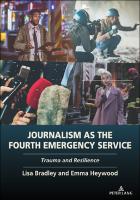
        Journalism as the Fourth Emergency Service

        Trauma and Resilience
        Thumbnail
        Download PDF Viewer
        Contributor(s)
        Bradley, Lisa (editor)
        Heywood, Emma (editor)
        Collection
        Knowledge Unlatched (KU); KU Open Services
        Language
        English
        Show full item record
        Abstract
        Journalists have often been considered the "fourth emergency service". They are first on the scene, alongside paramedics, fi re and police, running towards danger rather than away, and providing independent, veritable and crucial information in the public interest. And yet, unlike frontline workers, little (if any) counselling or training is offered to journalists on how to deal with the horrors they witness, and the trauma they absorb from being at the forefront of human suffering. Further, limited to no training is given to student journalists on how to prepare themselves for trauma, be it from war scenes to the everyday "death knock". New research is demonstrating a rise in post-traumatic stress disorder amongst journalists resulting from the "everyday" trauma they encounter. There is also a noticeable increase in reluctance from new journalists to undertake emotionally distressing assignments. Editors in industry are now calling for educators to invest in curricula that centre around understanding how to cope with distress and trauma, and why work like this is vital to facilitate the work journalists do hold power to account. This book investigates the cause and effect of trauma reporting on the journalist themselves and provides a toolkit for training journalists and practitioners to build resilience and prepare themselves for trauma. It draws on national and international experiences enabling readers to gain valuable insight into a range of contemporary issues and the contexts in which they may work. This edited book offers a blend of academic research studies, evidence-based practitioner interviews, and teaching resources drawing on the experiences of journalists and academics nationally and internationally.
        URI
        https://library.oapen.org/handle/20.500.12657/90201
        Keywords
        Bradley; education; Elizabeth; Emergency; Emma; Emma Heywood; emotional load; Fourth; Heywood; Howard; Journalism; Journalism as the Fourth Emergency Service; Lisa; Lisa Bradley; moral injury; Resilience; self-care; Service; stressors; Trauma; Trauma and Resilience; trauma training; journalism, moral injury, emotional load, stressors, resilience, self-care, education, Journalism as the Fourth Emergency Service.
        DOI
        10.3726/b21650
        ISBN
        9781636671987, 9781636671994, 9781636672007
        Publisher
        Peter Lang International Academic Publishers
        Publisher website
        https://www.peterlang.com/
        Publication date and place
        Bern, 2024
        Grantor
        • Knowledge Unlatched
        Classification
        Trauma and shock
        Media studies: internet, digital media and society
        Media studies: journalism
        Gender studies: women and girls
        News media and journalism
        Pages
        278
        Rights
        https://creativecommons.org/licenses/by/4.0/
        • Imported or submitted locally

        Browse

        All of OAPENSubjectsPublishersLanguagesCollections

        My Account

        LoginRegister

        Export

        Repository metadata
        Logo Oapen
        • For Librarians
        • For Publishers
        • For Researchers
        • Funders
        • Resources
        • OAPEN

        Newsletter

        • Subscribe to our newsletter
        • view our news archive

        Follow us on

        License

        • If not noted otherwise all contents are available under Attribution 4.0 International (CC BY 4.0)

        Credits

        • logo EU
        • This project received funding from the European Union's Horizon 2020 research and innovation programme under grant agreement No 683680, 810640, 871069 and 964352.

        OAPEN is based in the Netherlands, with its registered office in the National Library in The Hague.

        Director: Niels Stern

        Address:
        OAPEN Foundation
        Prins Willem-Alexanderhof 5
        2595 BE The Hague
        Postal address:
        OAPEN Foundation
        P.O. Box 90407
        2509 LK The Hague

        Websites:
        OAPEN Home: www.oapen.org
        OAPEN Library: library.oapen.org
        DOAB: www.doabooks.org


        Export search results

        The export option will allow you to export the current search results of the entered query to a file. Differen formats are available for download. To export the items, click on the button corresponding with the preferred download format.

        A logged-in user can export up to 15000 items. If you're not logged in, you can export no more than 500 items.

        To select a subset of the search results, click "Selective Export" button and make a selection of the items you want to export. The amount of items that can be exported at once is similarly restricted as the full export.

        After making a selection, click one of the export format buttons. The amount of items that will be exported is indicated in the bubble next to export format.