OAPEN Library: Recent submissions
Now showing items 11701-11720 of 49681
-
(2024)In the later stages of his career, Dimitris Pikionis embraced a new commission, that of crafting a children's park. This endeavour provided him with an opportunity to revisit and expand upon the thematic elements he had ...
-
(2024)Zen master Dōgen is renowned for being the first to extensively employ the term butsudō, meaning “the Way of Buddha”, within his seminal work, the Shōbōgenzō. Dōgen’s interpretation emphasises that Buddha's teachings are ...
-
(2024)This article delves into the issue of mabiki (infanticide) in the late Edo period by analysing three texts authored by prominent scholars belonging to a circle of philologists and historians known as kokugakusha. During ...
-
(2024)The character of nations was a prominent topic in 18th century intellectual debate, searching for criteria that could explain the great diversity of customs, institutions, religions and cultures of the world's peoples. ...
-
(2024)It is widely recognised that in Japan, the depiction of historical figures has been a recurring theme in both oral and written narratives, as well as various theatrical productions. One historical figure that has been a ...
-
(2024)Rosa Yasin Hasan's novel Guardians of the Air (2009) offers a glimpse into Syrian society prior to the revolution and civil war that devastated the country for over a decade. The novel's central character, Anat, works as ...
-
(2024)In the early 1970s some Japanese historians embarked on a critical examination of the overwhelmingly positive evaluation of the reforms, most notably Land reform, implemented by the Allied Forces during the Occupation ...
-
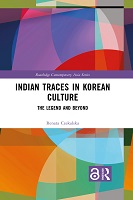
(2025)Indian traces in Korean Culture examines the enduring cross-cultural discourse between India and Korea over the centuries, emphasizing the transformative power of cultural exchange beyond geographical and temporal constraints. ...
-
(2024)The paper focuses on two kibyōshi (yellow covers) published in late 18th-century Japan: [Ote ryōri o shiru nomi] Daihi no senrokuhon and [Kannon kaichō] Mitsutakara rishō no wakatake. Both works incorporate elements of ...
-
(2024)During the Edo period (1603-1868) in Japan, ghost stories flourished. Some of these stories are particularly interesting for jurists analysing the Tokugawa legal system through the lens of popular culture. This article ...
-
(2024)Japanese Adult Computer Games feature a plethora of setting and themes, ranging from science fiction and fantasy to romantic comedies set in present-day Japan. A subset of these video games features historical or ...
-
(2024)Starting with Hashimoto's work in 1928 and continuing until recent times, the prevailing belief was that the reflex of the phoneme /*p/ of Proto-Japanese was a bilabial fricative [ɸ] as early as the Nara period. This ...
-
(2024)During his lifetime, Suzuki Takao, the well-known Japanese sociologist of language, developed a model for interpreting unfamiliar Japanese compounds by assigning a kun-reading to each constituent kanji.
-
(2024)Modern Japanese spelling conventions incorporate diacritical marks known as dakuten and handakuten. These marks are used to indicate voiced consonants and the presence of the voiceless bilabial plosive /p/, respectively. ...
-
(2024)In this essay, making use of concepts from the scholarship on rural modernism and Mark Fisher’s aesthetic reflection on the “weird” and the “eerie”, I analyze some texts in Japanese literature from the first three decades ...
-
(2024)Catholic author Endō Shūsaku (1923-1996) has gained worldwide acclaim for his novels and short stories that explore the conflicts between ethnicity, faith, and native Japanese religious sensibilities. A number of international ...
-
(2024)A significant portion of Tsushima Yūko’s body of work, particularly her early novels that brought her fame – Chōji (Child of Fortune, 1978), Hikari no ryōbun (Territory of Light, 1979), Yama o hashiru onna (The Woman Running ...
-
(2024)The present essay addresses the analysis of three fragments from the Tango no kuni fudoki (Record of the Tango province and its customs), which have reached us indirectly through various mediaeval sources. The Tango no ...
-
(2024)In nō plays, the senses of hearing and sight are closely interrelated. The plays often delve into the complexities of human connection and communication, especially in circumstances where physical presence is hindered. One ...
-
(2024)In my contribution, I analyse Dai Tōkyō hanjōki (Chronicles of Great Tokyo Flourishing, 1927) in an attempt to identify the salient features of a composite narrative pertaining to the Great Kantō Earthquake (1923) and the ...