
Logo Oapen
  • Join
    • Deposit
    • For Librarians
    • For Publishers
    • For Researchers
    • Funders
    • Resources
    • OAPEN
        View Item 
        •   OAPEN Home
        • View Item
        •   OAPEN Home
        • View Item
        JavaScript is disabled for your browser. Some features of this site may not work without it.

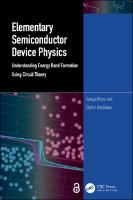
        Elementary Semiconductor Device Physics

        Proposal review

        Understanding Energy Band Formation Using Circuit Theory
        Thumbnail
        Download PDF Viewer
        Web Shop
        Author(s)
        Masu, Kazuya
        Amakawa, Shuhei
        Language
        English
        Show full item record
        Abstract
        This book by two leading experts on integrated circuit design adopts an untraditional approach to introducing semiconductor devices to beginners. The authors use circuit theory to provide a digestible explanation of energy band theory and understanding of energy band diagrams. After briefly summarizing the basics of semiconductors, the authors describe semiconductor devices from a circuit theoretic point of view, making the book especially suitable for circuit design students and engineers. Further to the emphasis on the circuit perspective, the book then uses circuit theory to introduce readers to the famously indigestible “energy bands” of crystalline solids. Additionally, the book explains how to read physics from “energy band diagrams” of semiconductor devices in great detail. The key to appreciating the real power of energy band diagrams is shown to lie in the understanding of the concept of the “quasi-Fermi levels,” introduced in 1949 by William Shockley but remaining elusive to date and therefore often omitted from energy band diagrams. To rectify this, some of the energy band diagrams presented in this book, complete with quasi-Fermi levels, were drawn using a device simulator (a.k.a. technology computer-aided design; TCAD), offering quantitative information about device physics. The book could, therefore, also serve as a hands-on course text in TCAD-drawn band diagram reading. Because no prior exposure to quantum mechanics is required and the book does not attempt to teach it, this book is ideal for students in various disciplines who may or may not be specializing in semiconductor devices. The numerous practical examples of reading TCAD-based energy-band diagrams are also invaluable to practicing semiconductor device engineers.
        URI
        https://library.oapen.org/handle/20.500.12657/101533
        Keywords
        semiconductors; p-n junction; MOS transistors; quasi-fermi levels; carrier dynamics; semiconductor device
        DOI
        10.1201/9781003439417
        ISBN
        9781040165416, 9781040165416, 9781003439417, 9781040165454, 9781032574479
        Publisher
        Taylor & Francis
        Publisher website
        https://taylorandfrancis.com/
        Publication date and place
        2024
        Grantor
        • Tokyo Institute of Technology - [...]
        Imprint
        CRC Press
        Classification
        Electronic devices and materials
        Electrical engineering
        Condensed matter physics (liquid state and solid state physics)
        Pages
        362
        Rights
        https://creativecommons.org/licenses/by-nc-nd/4.0/
        • Imported or submitted locally

        Browse

        All of OAPENSubjectsPublishersLanguagesCollections

        My Account

        LoginRegister

        Export

        Repository metadata
        Logo Oapen
        • For Librarians
        • For Publishers
        • For Researchers
        • Funders
        • Resources
        • OAPEN

        Newsletter

        • Subscribe to our newsletter
        • view our news archive

        Follow us on

        License

        • If not noted otherwise all contents are available under Attribution 4.0 International (CC BY 4.0)

        Credits

        • logo EU
        • This project received funding from the European Union's Horizon 2020 research and innovation programme under grant agreement No 683680, 810640, 871069 and 964352.

        OAPEN is based in the Netherlands, with its registered office in the National Library in The Hague.

        Director: Niels Stern

        Address:
        OAPEN Foundation
        Prins Willem-Alexanderhof 5
        2595 BE The Hague
        Postal address:
        OAPEN Foundation
        P.O. Box 90407
        2509 LK The Hague

        Websites:
        OAPEN Home: www.oapen.org
        OAPEN Library: library.oapen.org
        DOAB: www.doabooks.org


        Export search results

        The export option will allow you to export the current search results of the entered query to a file. Differen formats are available for download. To export the items, click on the button corresponding with the preferred download format.

        A logged-in user can export up to 15000 items. If you're not logged in, you can export no more than 500 items.

        To select a subset of the search results, click "Selective Export" button and make a selection of the items you want to export. The amount of items that can be exported at once is similarly restricted as the full export.

        After making a selection, click one of the export format buttons. The amount of items that will be exported is indicated in the bubble next to export format.