
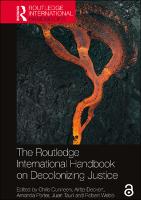
The Routledge International Handbook on Decolonizing Justice
Proposal review
 Download
 Web Shop
Contributor(s)
Cunneen, Chris (editor)
Deckert, Antje (editor)
Porter, Amanda (editor)
Tauri, Juan (editor)
Webb, Robert (editor)
Language
EnglishAbstract
The Routledge International Handbook on Decolonizing Justice focuses on the growing worldwide movement aimed at decolonizing state policies and practices, and various disciplinary knowledges including criminology, social work and law. The collection of original chapters brings together cutting-edge, politically engaged work from a diverse group of writers who take as a starting point an analysis founded in a decolonizing, decolonial and/or Indigenous standpoint. Centering the perspectives of Black, First Nations and other racialized and minoritized peoples, the book makes an internationally significant contribution to the literature. The chapters include analyses of specific decolonization policies and interventions instigated by communities to enhance jurisdictional self-determination; theoretical approaches to decolonization; the importance of research and research ethics as a key foundation of the decolonization process; crucial contemporary issues including deaths in custody, state crime, reparations, and transitional justice; and critical analysis of key institutions of control, including police, courts, corrections, child protection systems and other forms of carcerality. The handbook is divided into five sections which reflect the breadth of the decolonizing literature: • Why decolonization? From the personal to the global • State terror and violence • Abolishing the carceral • Transforming and decolonizing justice • Disrupting epistemic violence This book offers a comprehensive and timely resource for activists, students, academics, and those with an interest in Indigenous studies, decolonial and post-colonial studies, criminal legal institutions and criminology. It provides critical commentary and analyses of the major issues for enhancing social justice internationally. The Open Access version of this book, available at www.taylorfrancis.com, has been made available under a Creative Commons Attribution-Non Commercial-No Derivatives 4.0 license.
Keywords
decolonizing justice; decolonial; Indigenous; theoretical approaches to decolonization; deaths in custody; state crime; police; carcerality; post-colonial; racialized and minoritized peoples; Black perspectives; First Nation perspectives; decolonization policies; decolonization process; State terror and violence; Abolishing the carceral; Transforming and decolonizing justice; Disrupting epistemic violence; courts; child protection systems; corrections; reparations; transitional justice; Follow; Indigenous Peoples; UNDOI
10.4324/9781003176619ISBN
9781000904017, 9781000904017, 9781032009797, 9781000904048, 9781032009773, 9781003176619OCN
1389364158Publisher
Taylor & FrancisPublisher website
https://taylorandfrancis.com/Publication date and place
Oxford, 2023Grantor
Imprint
RoutledgeSeries
Routledge International Handbooks,Classification
Social law and Medical law
Colonialism and imperialism
National liberation and independence
Cultural studies
Ethnic studies
Criminal justice law
Police and security services
Sentencing and punishment
Social and ethical issues
Legal aspects of criminology
International law
Literary studies: postcolonial literature
Penology and punishment
Anthropology
Gender studies, gender groups
Sociology