
Logo Oapen
  • Join
    • Deposit
    • For Librarians
    • For Publishers
    • For Researchers
    • Funders
    • Resources
    • OAPEN
        View Item 
        •   OAPEN Home
        • View Item
        •   OAPEN Home
        • View Item
        JavaScript is disabled for your browser. Some features of this site may not work without it.

        Negotiating in/visibility

        Women, science, engineering and medicine in the twentieth century
        Thumbnail
        Download PDF Viewer
        Web Shop
        Contributor(s)
        Bonea, Amelia (editor)
        Nastasa-Matei, Irina (editor)
        Language
        English
        Show full item record
        Abstract
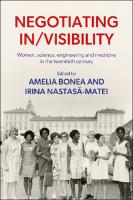
        This volume explores, from global, multilingual and intersectional perspectives, the experiences of women in science, engineering and medicine in the twentieth century. Some, like the American evolutionary biologist Lynn Margulis, were fairly visible actors in the academic and public arenas of professional science. Others, like the doctors working in secondary schools in interwar Romania or those who struggled to alleviate ‘women’s illnesses’ in famine-stricken rural areas during China’s Great Leap Forward, have been largely invisible – as medical practitioners, creators of knowledge, educators and subjects of historical inquiry. The volume investigates the nature and extent of women’s in/visibility in science, engineering and medicine in the twentieth century, seeking to document the factors that underpinned it and understand how women navigated their circumstances. When and why did women become invisible? When and how did they seek visibility? Was invisibility always a form of discrimination, exclusion and misrecognition or could it also become a strategy of resistance and survival? Drawing on hitherto-little-explored archives in Asia, Europe and North America, the contributors examine the in/visibility of women across multiple sites of medical practice, science-making, pedagogy and communication, such as the laboratory, the university, the clinic, the hospital, the home, the school and the media. They show that invisibility was the outcome of power asymmetries based on intersecting factors like gender, race, ethnicity, class, caste and age, and that women were not only present in science, engineering and medicine, but also exercised considerable agency in trying to negotiate institutional and intellectual hierarchies.
        URI
        https://library.oapen.org/handle/20.500.12657/105567
        Keywords
        communication networks; decolonization; discrimination; domestic sphere; gender equality; gender roles; grassroots science; knowledge production; laboratory culture; marginalization; multingual archive; Nobel Prize; science communication; twentieth century; women in science
        DOI
        10.7765/9781526178398
        ISBN
        9781526178398, 9781526178398, 9781526178381
        Publisher
        Manchester University Press
        Publisher website
        https://manchesteruniversitypress.co.uk/
        Publication date and place
        Manchester, 2025
        Imprint
        Manchester University Press
        Classification
        History of science
        History of medicine
        20th century, c 1900 to c 1999
        General and world history
        Gender studies: women and girls
        History of engineering and technology
        Pages
        400
        Rights
        https://creativecommons.org/licenses/by-nc-nd/4.0/
        • Imported or submitted locally

        Browse

        All of OAPENSubjectsPublishersLanguagesCollections

        My Account

        LoginRegister

        Export

        Repository metadata
        Logo Oapen
        • For Librarians
        • For Publishers
        • For Researchers
        • Funders
        • Resources
        • OAPEN

        Newsletter

        • Subscribe to our newsletter
        • view our news archive

        Follow us on

        License

        • If not noted otherwise all contents are available under Attribution 4.0 International (CC BY 4.0)

        Credits

        • logo EU
        • This project received funding from the European Union's Horizon 2020 research and innovation programme under grant agreement No 683680, 810640, 871069 and 964352.

        OAPEN is based in the Netherlands, with its registered office in the National Library in The Hague.

        Director: Niels Stern

        Address:
        OAPEN Foundation
        Prins Willem-Alexanderhof 5
        2595 BE The Hague
        Postal address:
        OAPEN Foundation
        P.O. Box 90407
        2509 LK The Hague

        Websites:
        OAPEN Home: www.oapen.org
        OAPEN Library: library.oapen.org
        DOAB: www.doabooks.org


        Export search results

        The export option will allow you to export the current search results of the entered query to a file. Differen formats are available for download. To export the items, click on the button corresponding with the preferred download format.

        A logged-in user can export up to 15000 items. If you're not logged in, you can export no more than 500 items.

        To select a subset of the search results, click "Selective Export" button and make a selection of the items you want to export. The amount of items that can be exported at once is similarly restricted as the full export.

        After making a selection, click one of the export format buttons. The amount of items that will be exported is indicated in the bubble next to export format.