
Logo Oapen
  • Join
    • Deposit
    • For Librarians
    • For Publishers
    • For Researchers
    • Funders
    • Resources
    • OAPEN
        View Item 
        •   OAPEN Home
        • View Item
        •   OAPEN Home
        • View Item
        JavaScript is disabled for your browser. Some features of this site may not work without it.

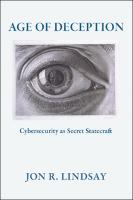
        Age of Deception

        Cybersecurity as Secret Statecraft
        Thumbnail
        Download PDF Viewer
        Download
        Web Shop
        Author(s)
        Lindsay, Jon R.
        Language
        English
        Show full item record
        Abstract
        At the heart of cybersecurity lies a paradox: Cooperation makes conflict possible. In Age of Deception , Jon R. Lindsay shows that widespread trust in cyberspace enables espionage and subversion. While such acts of secret statecraft have long been part of global politics, digital systems have dramatically expanded their scope and scale. Yet success in secret statecraft hinges less on sophisticated technology than on political context. To make sense of this, Lindsay offers a general theory of intelligence performance—the analogue to military performance in battle—that explains why spies and hackers alike depend on clandestine organizations and vulnerable institutions. Through cases spanning codebreaking at Bletchley Park during WWII to the weaponization of pagers by Israel in 2024, he traces both continuity and change in secret statecraft. Along the way, he explains why popular assumptions about cyber warfare are profoundly misleading. Offense does not simply dominate defense, for example, because the same digital complexity that expands opportunities for deception also creates potential for self-deception and counterdeception. Provocative and persuasive, Age of Deception offers crucial insights into the future of secret statecraft in cyberspace and beyond.
        URI
        https://library.oapen.org/handle/20.500.12657/110019
        Keywords
        Intelligence and covert action; Information security; Cyberspace politics; Disinformation and information operations; Weaponized interdependence
        DOI
        10.7298/tn7j-7158
        ISBN
        9781501783234, 9781501783234, 9781501783234, 9781501783227
        Publisher
        Cornell University Press
        Publisher website
        https://www.cornellpress.cornell.edu/
        Publication date and place
        Ithaca, 2025
        Imprint
        Cornell University Press
        Series
        Cornell Studies in Security Affairs,
        Classification
        Warfare and defence
        Political science and theory
        Geopolitics
        Pages
        318
        Rights
        https://creativecommons.org/licenses/by-nc-nd/4.0/
        • Imported or submitted locally

        Browse

        All of OAPENSubjectsPublishersLanguagesCollections

        My Account

        LoginRegister

        Export

        Repository metadata
        Logo Oapen
        • For Librarians
        • For Publishers
        • For Researchers
        • Funders
        • Resources
        • OAPEN

        Newsletter

        • Subscribe to our newsletter
        • view our news archive

        Follow us on

        License

        • If not noted otherwise all contents are available under Attribution 4.0 International (CC BY 4.0)

        Credits

        • logo EU
        • This project received funding from the European Union's Horizon 2020 research and innovation programme under grant agreement No 683680, 810640, 871069 and 964352.

        OAPEN is based in the Netherlands, with its registered office in the National Library in The Hague.

        Director: Niels Stern

        Address:
        OAPEN Foundation
        Prins Willem-Alexanderhof 5
        2595 BE The Hague
        Postal address:
        OAPEN Foundation
        P.O. Box 90407
        2509 LK The Hague

        Websites:
        OAPEN Home: www.oapen.org
        OAPEN Library: library.oapen.org
        DOAB: www.doabooks.org


        Export search results

        The export option will allow you to export the current search results of the entered query to a file. Differen formats are available for download. To export the items, click on the button corresponding with the preferred download format.

        A logged-in user can export up to 15000 items. If you're not logged in, you can export no more than 500 items.

        To select a subset of the search results, click "Selective Export" button and make a selection of the items you want to export. The amount of items that can be exported at once is similarly restricted as the full export.

        After making a selection, click one of the export format buttons. The amount of items that will be exported is indicated in the bubble next to export format.