
Logo Oapen
  • Join
    • Deposit
    • For Librarians
    • For Publishers
    • For Researchers
    • Funders
    • Resources
    • OAPEN
        View Item 
        •   OAPEN Home
        • View Item
        •   OAPEN Home
        • View Item
        JavaScript is disabled for your browser. Some features of this site may not work without it.

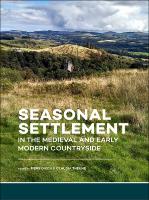
        Seasonal Settlement in the Medieval and Early Modern Countryside
        Thumbnail
        Download PDF Viewer
        Web Shop
        Contributor(s)
        Dixon, Piers (editor)
        Theune, Claudia (editor)
        Language
        English
        Show full item record
        Abstract
        For the first time seasonality is placed at the centre of the study of rural settlement. Using a Europe-wide approach, it provides a primer of examples, of techniques and of ideas for the identification and understanding of seasonal settlement. As such, it marks an important new step in the interpretation of the use of the countryside by historic communities linked to the annual passage of the year. The particular studies are introduced by an opening essay which draws wider conclusions about the study of seasonal settlement, followed by 31 papers by authors from all parts of Europe and beyond. By its very nature ephemeral, seasonal settlement in the medieval and early modern periods is less well researched than permanent settlement. It is often presumed that seasonal settlement is the result of transhumance, but it was only one facet of seasonal settlement. It was also necessitated by other forms of economic activity, such as fishing, charcoal-burning, or iron-smelting, including settlements of pastoralists such as nomads, drovers, herders as well as labourers’ huts within the farming context. The season a settlement was occupied varied from one activity to another and from one place to another - summer is good for grazing in many mountainous areas, but winter proved best for some industrial processes. While upland and mountainous settlements built of stone are easily recognised, those that use wood and more perishable materials are less obvious. Despite this, the settlements of nomadic pastoralists in both tundra and desert or of fishermen in the Baltic region are nonetheless identifiable. Yet for all that definitive recognition of seasonal settlement is rarely possible on archaeological grounds alone. Although material remains can be of particular importance, generally it is the combination of documentary information, ethnography, geographical context and palaeo-environmental data that provide frameworks for interpreting seasonal settlements.
        URI
        https://library.oapen.org/handle/20.500.12657/110087
        Keywords
        Seasonal settlement; Medieval archaeology; Post-medieval archaeology; Rural settlement; Medieval trade; Domestic sites; Settlement archaeology
        DOI
        10.59641/qgv795js
        ISBN
        9789464270099, 9789464270099, 9789464270105, 9789464270112
        Publisher
        Sidestone Press
        Publisher website
        https://www.sidestone.com/
        Publication date and place
        Leiden, 2021
        Imprint
        Sidestone Press Academics
        Series
        RURALIA, 13
        Classification
        Archaeology
        European history: medieval period, middle ages
        Pages
        370
        • Imported or submitted locally

        Browse

        All of OAPENSubjectsPublishersLanguagesCollections

        My Account

        LoginRegister

        Export

        Repository metadata
        Logo Oapen
        • For Librarians
        • For Publishers
        • For Researchers
        • Funders
        • Resources
        • OAPEN

        Newsletter

        • Subscribe to our newsletter
        • view our news archive

        Follow us on

        License

        • If not noted otherwise all contents are available under Attribution 4.0 International (CC BY 4.0)

        Credits

        • logo EU
        • This project received funding from the European Union's Horizon 2020 research and innovation programme under grant agreement No 683680, 810640, 871069 and 964352.

        OAPEN is based in the Netherlands, with its registered office in the National Library in The Hague.

        Director: Niels Stern

        Address:
        OAPEN Foundation
        Prins Willem-Alexanderhof 5
        2595 BE The Hague
        Postal address:
        OAPEN Foundation
        P.O. Box 90407
        2509 LK The Hague

        Websites:
        OAPEN Home: www.oapen.org
        OAPEN Library: library.oapen.org
        DOAB: www.doabooks.org


        Export search results

        The export option will allow you to export the current search results of the entered query to a file. Differen formats are available for download. To export the items, click on the button corresponding with the preferred download format.

        A logged-in user can export up to 15000 items. If you're not logged in, you can export no more than 500 items.

        To select a subset of the search results, click "Selective Export" button and make a selection of the items you want to export. The amount of items that can be exported at once is similarly restricted as the full export.

        After making a selection, click one of the export format buttons. The amount of items that will be exported is indicated in the bubble next to export format.