
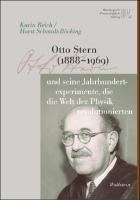
Otto Stern (1888-1969) und seine Jahrhundertexperimente, die die Welt der Physik revolutionierten
 Download
Abstract
Otto Stern – physicist, Nobel Prize winner, scientific revolutionaryOtto Stern received his doctorate in physical chemistry in Breslau in 1912. He worked in Prague, Zurich, and Frankfurt am Main, where the world-famous Stern-Gerlach experiment took place on February 8, 1922, as well as in Rostock and Hamburg. Between 1923 and 1933, in collaboration with a team of outstanding researchers, he produced thirty fundamental papers on the molecular beam method, including the measurement of the magnetic moment of the proton. Stern's path to forced emigration took him to the USA in 1933, first to Pittsburgh and then to Berkeley in 1945. He was awarded the Nobel Prize in Physics in 1943. In the post-war period, he traveled to Europe almost every year to maintain contact with former colleagues; he never visited Hamburg again. After Stern's death, lively commemorations of Otto Stern and his extremely successful molecular beam method took place, initially mainly in Hamburg and later also in Frankfurt am Main.
Keywords
History of natural sciences; History of science; Physical chemistry; Theoretical physics; Experimental physics; Experiments; Anti-Semitism; National Socialism; Seizure of power; Flight; Exile; Emigration; America; Nobel Prize; Jewish historyDOI
10.46500/83535770ISBN
9783835381865, 9783835381865, 9783835357709Publisher
Wallstein VerlagPublisher website
https://www.wallstein-verlag.de/Publication date and place
Göttingen, 2026Series
Wissenschaftler in Hamburg, 9Classification
Autobiography: science, technology and medicine