
Logo Oapen
  • Join
    • Deposit
    • For Librarians
    • For Publishers
    • For Researchers
    • Funders
    • Resources
    • OAPEN
        View Item 
        •   OAPEN Home
        • View Item
        •   OAPEN Home
        • View Item
        JavaScript is disabled for your browser. Some features of this site may not work without it.

        The lexeme in descriptive and theoretical morphology
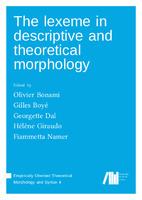
        Thumbnail
        Download PDF Viewer
        Contributor(s)
        Bonami, Oliver (editor)
        Boyé, Gilles (editor)
        Dal, Georgette (editor)
        Giraudo, Hélène (editor)
        Namer, Fiammetta (editor)
        Collection
        Knowledge Unlatched (KU); Language Science Press 2018-2020
        Number
        103602
        Language
        English
        Show full item record
        Abstract
        After being dominant during about a century since its invention by Baudouin de Courtenay at the end of the nineteenth century, morpheme is more and more replaced by lexeme in contemporary descriptive and theoretical morphology. The notion of a lexeme is usually associated with the work of P. H. Matthews (1972, 1974), who characterizes it as a lexical entity abstracting over individual inflected words. Over the last three decades, the lexeme has become a cornerstone of much work in both inflectional morphology and word formation (or, as it is increasingly been called, lexeme formation). The papers in the present volume take stock of the descriptive and theoretical usefulness of the lexeme, but also adress many of the challenges met by classical lexeme-based theories of morphology.
        URI
        http://library.oapen.org/handle/20.500.12657/28279
        Keywords
        Linguistics
        ISBN
        9783961101108
        OCN
        1065536352
        Publisher
        Language Science Press
        Publisher website
        https://langsci-press.org/
        Publication date and place
        Berlin, 2018-09-26
        Grantor
        • Knowledge Unlatched - 103602 - Language Science Press 2018 - 2020
        Series
        Empirically Oriented Theoretical Morphology and Syntax,
        Public remark
        21-7-2020 - No DOI registered in CrossRef for ISBN 9783961101115
        Rights
        https://creativecommons.org/licenses/by/4.0/legalcode
        • Imported or submitted locally

        Browse

        All of OAPENSubjectsPublishersLanguagesCollections

        My Account

        LoginRegister

        Export

        Repository metadata
        Logo Oapen
        • For Librarians
        • For Publishers
        • For Researchers
        • Funders
        • Resources
        • OAPEN

        Newsletter

        • Subscribe to our newsletter
        • view our news archive

        Follow us on

        License

        • If not noted otherwise all contents are available under Attribution 4.0 International (CC BY 4.0)

        Credits

        • logo EU
        • This project received funding from the European Union's Horizon 2020 research and innovation programme under grant agreement No 683680, 810640, 871069 and 964352.

        OAPEN is based in the Netherlands, with its registered office in the National Library in The Hague.

        Director: Niels Stern

        Address:
        OAPEN Foundation
        Prins Willem-Alexanderhof 5
        2595 BE The Hague
        Postal address:
        OAPEN Foundation
        P.O. Box 90407
        2509 LK The Hague

        Websites:
        OAPEN Home: www.oapen.org
        OAPEN Library: library.oapen.org
        DOAB: www.doabooks.org


        Export search results

        The export option will allow you to export the current search results of the entered query to a file. Differen formats are available for download. To export the items, click on the button corresponding with the preferred download format.

        A logged-in user can export up to 15000 items. If you're not logged in, you can export no more than 500 items.

        To select a subset of the search results, click "Selective Export" button and make a selection of the items you want to export. The amount of items that can be exported at once is similarly restricted as the full export.

        After making a selection, click one of the export format buttons. The amount of items that will be exported is indicated in the bubble next to export format.