
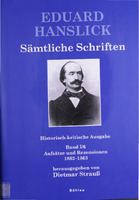
Eduard Hanslick - Sämtliche Schriften. Historisch-kritische Ausgabe
Band I/6: Aufsätze und Rezensionen 1862-1863
 Download
Contributor(s)
Strauß, Dietmar (editor)
Collection
Austrian Science Fund (FWF)Language
GermanAbstract
The present sixth volume of the new historic-critical complete edition of Eduard Hanslick´s works contains texts of the years 1862 to 1863, which are for the most part contributions from the Vienna "Presse". Some articles were published shortly after in national music journals such as the "Niederrheinische Musik-Zeitung" or the Berlin music journal "Echo". Hanslick revised som of them later for his well-known anthologies ("Die moderne Oper", aus dem Konzertsaal. Geschichte des Konzertwesens in Wien, II2). As before these texts were provided with lists of variant readings, which are printed subsequent to the respective article. The principles of publication were not changed. Minor variations are: different spelling, change from spaced writing to normal distance of characters or vice versa, smaller modification of the wording, updating or additions. Major changes mainly consist in leaving out large parts of the text or rearranging text passages from different sources to particular subjects. The fundamental change in Hanslick´s occupation as a critic as can be seen exactly from the 1860s, that is his stronger attention to reviewing the performance cannot be substantiated by his own editions so well because he often left out parts related to the concert. From that point of view this edition provides not only a better survey of the Vienna concert life in these years than Hanslick´s own edition but it also notes down in a much more precise way his changed approach to writing. Most of the texts, however, are completely unknown today.
The main essay in the comment part deals with the music-aesthetic consequences of the phenomenon of boredom, the typical syndrome of the 19th century, which Hanslick´s reviews shed some light on. It becomes clear that there are more criteria in Hanslick that are important for an assessment of a work than those laid down in "Vom Musikalisch-Schönen".
An important position in Hanslick´s life as a music critik take his trips to music festivals or world expositions. His travel diaries are still very informative and shown an open-minded cosmopolitan. Hanslick´s report on the bustle of the 1862 word exposition in London from an initially neutral attitude of an observer seems in a certain way to turn into a surrealistic inferno of the arising modern age and confirms unconsciously what Walter Benjamin realized first and formulated in his "Passagenwerk". This matter is dealt with a particular length in the notes, which as before briefly characterize, annotate or analyse for its aesthetic relevance every single text. Added to the annotations is an excerpt from a letter by August Wilhelm Ambros, which illustrates some aspects from Hanslick´s aesthetic of boredom from a different point of view. Der vorliegende sechste Band der neuen historisch-kritischen Gesamtausgabe der Schriften von Eduard Hanslick enthält Texte der Jahre 1862 bis 1863. Es sind überwiegend Beiträge aus der Wiener "Presse". Manche Artikel erschienen kurz darauf in überregionalen Musikzeitschriften wie der "Niederrheinischen Musik-Zeitung" oder der Berliner-Musikzeitung "Echo". Einen Teil überarbeitete Hanslick später für seine bekannten Sammelbände ("Die moderne Oper", "Aus dem Concertsaal. Geschichte des Concertwesens in Wien, II"). Für diese Texte wurden wie bisher Lesartenverzeichnisse erstellt, die im Anschluss an die jeweiligen Zeitungsartikel abgedruckt sind. Die Editionsprinzipien blieben gleich. Geringfügige Varianten sind: andere Schreibweise, Wechsel von Sperrdruck zu normalem Zeichenabstand oder umgekehrt, kleinere Formulierungsänderungen, Aktualisierungen oder Hinzufügungen. Gravierende Änderungen bestehen hauptsächlich im Wegfall großer Textpartien oder der Neumontage von Textpassagen aus verschiedenen Quellen zu bestimmten Themen. Die grundsätzliche Änderung in Hanslicks Kritikertätigkeit, wie sie gerade ab den 1860-er Jahren festzustellen ist, nämlich seine stärkere Zuwendung zur Leistungskritik, kann man seinen eigenen Editionen nicht so gut belegen, weil er oft aufführungsbezogene Teile weggelassen hat. Insofern gibt diese Ausgabe nicht nur einen besseren Überblick über das Wiener Konzertleben dieser Jahre als Hanslicks eigene Edition, sondern verzeichnet viel genauer seine geänderte Schreibhaltung. Die meisten Texte jedoch sind heute gänzlich unbekannt.
Der Hauptessay im Kommentarteil beschäftigt sich mit den musikästhetischen Konsequenzen aus dem Phänomen der Langeweile, dem typischen Krankheitsbild des 19. Jahrhunderts, zu dem Hanslicks Kritiken manche Erhellung bringen. Es wird deutlich, dass es bei Hanslick noch andere wichtige Kriterien für eine Werkbewertung gilbt als die in "Vom Musikalisch-Schönen" festgelegten.
Eine wichtige Stellung in Hanslicks Leben als Musikkritiker nehmen seine Reisen zu Musikfesten oder zu Weltausstellungen ein. Seine Reiseberichte sind immer noch sehr informativ und zeigen einen weltoffenen Kosmopoliten. Hanslicks Referat über den Betrieb auf der Londoner Weltausstellung 1862 aus einer zunächst neutralen Beobachterhaltung gerät zu einem surrealistisch anmutenden Inferno der aufkommenden Moderne und bestätigt unbewußt Erkenntnisse, die Walter Benjamin zuerst in seinem "Passagenwerk" formulierte. Dies wird in den Erläuterungen, die wie bisher knapp die einzelnen Texte charakterisieren, kommentieren oder auf ästhetische Relevanz in befragen, besonders ausführlich behandelt. Dem Kommentarteil ist ein Auszug aus einem Brief von August Wilhelm Ambros beigefügt, der einige Sachverhalte aus Hanslicks Ästhetik der Langeweile aus einer anderen Perspektive beleuchtet.
Der Band schließt mit einem wissenschaftlichen Apparat (Verzeichnis der emedierten Druckfehler, Abkürzungsverzeichnis, Literaturverzeichnis und Personenindex).
Keywords
aesthetics of music; music of the 19th century; Wagner; Verdi and Italian Opera; history of concerts in Vienna; sources of Anti-Wagnerism; Gesang; WienDOI
10.26530/oapen_574813ISBN
9783205779902OCN
1030819760Publisher
BrillPublisher website
https://brill.com/Publication date and place
2008Grantor
Imprint
BöhlauClassification
Music