
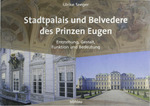
Stadtpalais und Belvedere des Prinzen Eugen
Entstehung, Gestalt, Funktion und Bedeutung
 Download
Abstract
Prince Eugene of Savoy, contemporary and companion in arms of the first Duke of Marlborough, was the architectural patron of two of the most important buildings of the Viennese baroque, viz. the Stadtpalais (city mansion) and the Belvedere, a suburban garden palace. In spite of the common patron, so far the two buildings were considered quite separately by the research on the Viennese baroque, presumably because of the emphasis on the two different, very prominent architects, Johann Bernhard Fischer von Erlach and Johann Lucas von Hildebrandt.
In the unified view presented in the present work, attention is focussed not only on the architecture but also on the sequences of rooms, on their interior decoration, and - in the case of the Belvedere - on the conceptual relationship between garden and buildings. Starting point is the question: "What was the self-representation intended by the Prince, who had not been raised in the Habsburg monarchy but at the French court?" The investigation of the origins of the various elements of the interior decoration and of the messages going with their provenance was helped by the fortunate circumstance that not only are the buildings well preserved but that, through the contemporary engravings and drawings of Salomon Kleiner, we are well informed on the original interiors of the buildings. Together with newly discovered written sources, this has allowed the complicated plannings, construction and decoration history of the two palaces to be clarified.
The main results may be summarized as follows. Prince Eugene of Savoy wished to conform, on a high level, to the traditions and the style of the Viennese nobility but without foregoing the French achievements in living comfort and elegance he was acquainted with from his time at the French court. As his carrier progressed, this 'French component' was enhanced and made increasingly visible. Little prominence was given to the relationship of the Prince to the ruling house of Savoy, presumably because he wanted to leave no doubt that he owed his position as one of the leading military and political leaders of the time not to family connections but to his own achievements. Die beiden Wiener Bauten des Prinzen Eugen von Savoyen, das Stadtpalais in der Himmelpfortgasse und die Vorstadtanlage Belvedere, wurden bislang, ungeachtet des gemeinsamen Auftraggebers, nicht als Einheit behandelt. Dies dürfte an der künstlermonographisch dominierten Wahrnehmung dieser für den Wiener Barock sehr bedeutsamen Bauten als Werke der beiden prominenten Architekten, Johann Bernhard Fischer von Erlach und Johann Lukas von Hildebrandt, gelegen haben.
Ausgangspunkt der gemeinsamen Betrachtung im vorliegenden Werk ist die Frage nach der vom Prinzen Eugen, der ja nicht in der Habsburger Monarchie aufgewachsen war, intendierten Selbstdarstellung. Zu ihrer Beantwortung werden die Raumfolgen, die Ausstattung der Räume und - für das Belvedere - der konzeptionelle Zusammenhang von Wohngebäuden und Garten gleichberechtigt mit der Architektur herangezogen. Dabei erwies es sich als Glücksfall, daß beide Anlagen sehr gut erhalten und insbesondere die zeitgenössisch überaus wichtige Innenausstattungen durch die Stiche und Stichvorzeichnungen des Augsburger Vedutenzeichners Salomon Kleiner gut dokumentiert sind. Die architekturikonologische Vorgehensweise, bei der die Herkunft der einzelnen Ausstattungselemente erforscht und die mit der Herkunft seinerzeit möglicherweise einhergehende Bedeutung untersucht wird, hat zu einer Fülle von neuen Erkenntnissen vor allem zur zeitgenössischen Wahrnehmung der Räume geführt und, zum Teil mit Hilfe bisher unbekannter Schriftquellen, die komplizierte und bislang nur unvollständig verstandene Bau- und Ausstattungsgeschichte der beiden Anlagen erhellt.
Als übergeordnete Erkenntnis ergibt sich, daß sich Prinz Eugen auf hohem Niveau in die Wiener Gegebenheiten und Traditionen einordnete, dabei aber nicht auf die ihm aus seiner Pariser Jugendzeit vertrauten französischen Wohn- und Ausstattungserrungenschaften verzichtete. Die "französische Komponente" wurde im Laufe des Werdegangs des Prinzen zunehmend verstärkt und zunehmend nach außen getragen. Die Eigenständigkeit seiner politischen und militärischen Leistungen unterstrich der Prinz unter anderem dadurch, daß in seiner Repräsentation seine Zugehörigkeit zum regierenden Haus Savoyen nur eine untergeordnete Rolle spielte.
Keywords
Prince Eugene of Savoy; Viennese baroque; Prinz Eugen; Wiener Barock; Eugen von Savoyen; Frankreich; Schloss Belvedere; StadtpalaisDOI
10.26530/oapen_574810ISBN
9783205771906OCN
743293966Publication date and place
2004Grantor
Imprint
BöhlauClassification
History