
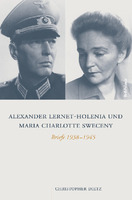
Alexander Lernet-Holenia und Maria Charlotte Sweceny
Briefe 1938-1945
 Download
Abstract
In the centre of this study stand some 154 letters exchanged between the Austrian writer Alexander Lernet-Holenia (1897-1976) and Maria Charlotte ("Lotte") Sweceny (née Stein, 1904-1956), the co-proprietor of the Viennese publishing house Manz, between 1938 and 1945. The transcripts are followed by a commentary that aims to elucidate the historical, individual and geographical references. A methodological note explains the corpus' provenance and method of transcribing and commenting on the letters adopted in the thesis. The last chapter of this study is devoted to Lotte Sweceny, the letters' addressee, and her family background.
The letters' existence is due to the fact that the couple was separated by the outbreak of WW II and continued their relationship through correspondence. In September 1939 Lernet took part in the "Wehrmacht's" raid on Poland and was lightly wounded. As a result he spent the rest of the war on a leave of absence in his house in St. Wolfgang and, after September 1941, in Berlin. There, he worked as head of development of the "Heeresfilmstelle" (an office in charge of producing NS propaganda films), writing scripts himself and evaluating those by others. In these years, two of his most important novels, Mars im Widder (Mars in Aries) and Beide Sizilien (The Two Sicilies), were written - both are today considered as running counter to NS propaganda. Lotte Sweceny and her friends found their way into the set of characters and into the plot of Mars in Aries. The collection of poems Die Trophae (The Trophy) also originated from these years. When published in 1946, Lernet dedicated this work - which he considered to be his best - to Lotte Sweceny.
The letters contain important background and numerous insights about the genesis and subsequent publication of these works. They also provide biographical details that shed light on the conditions of Lernet-Holenia's life and work during these years. Inter alia, they illuminate the circumstances surrounding Lernet-Holenia's posting to and role in the "Heeresfilmstelle". The writer considered his duties there dull and counterproductive to his actual work and unsurprisingly tried to escape from them as soon as possible. The thesis also addresses certain controversial issues in Lernet-Holenia's biography, in particular his involvement with the Nazi regime and his views on antisemitism: The way Lernet-Holenia writes about the regime and its protagonists in the letters suggests a clear political and intellectual distance to the "Third Reich" and thus reinforces scholarly voices that have, in this regard, already spoken in favor of the author. His use of a certain cipher in his letters even indicates that Lernet-Holenia was in touch with victims (or at least opponents) of the Nazi regime on behalf of Lotte Sweceny, the latter being half-Jewish herself. His personal and private dissociation from the Nazis did not, however, keep Lernet-Holenia from participating in their apparatus as long as he considered it beneficial for his career and/or his personal safety.
Lotte Sweceny, who was married to an "Aryan" industrialist, came from the assimilated Jewish bourgeoisie of Vienna. The stimulating atmosphere of her parental home was, in part, the product of the commitment of the two preceding generations to assimilate. The chapter also deals with Lotte's marriage with Otto C. Sweceny - a marriage that was intended as a liberal experiment - and with the circle of friends consisting of architects, writers and others portrayed by the Austrian publicist Milan Dubrovic. Zentrum der vorliegenden Arbeit bildet die Edition des Briefwechsels zwischen dem österreichischen Schriftsteller Alexander Lernet-Holenia (1897-1976) und Maria Charlotte ("Lotte") Sweceny (geb. Stein, 1904-1956), Gesellschafterin des Wiener Verlags Manz, während der Jahre 1938 bis 1945. Ein einleitender Aufsatz bietet einen Forschungsüberblick, gibt den Inhalt der Briefe wieder und analysiert ihre Bedeutung für Biografie und Werk Alexander Lernet-Holenias. Auf die Transkripte der 154 Briefe folgt der Kommentar, der die in diesen vorhandenen Bezüge historischer, personeller, geografischer und sonstiger Art erläutert. Ein editorischer Bericht gibt Aufschluss über die Provenienz des Korpus' sowie die Methode von Transkription und Kommentierung. Das abschließende Kapitel widmet sich Lotte Sweceny, der Adressatin der Briefe, und ihrem familiären Hintergrund.
Die Existenz der Briefe verdankt sich der Tatsache, dass das Paar durch den Ausbruch des Zweiten Weltkriegs getrennt wurde und seine Beziehung mit Hilfe von Briefen fortführte. Im September 1939 nahm der Wehrmachts-Offizier Alexander Lernet-Holenia am Überfall auf Polen teil, wurde verwundet und verbrachte den Rest des Krieges beurlaubt in seinem Haus in St. Wolfgang bzw. ab September 1941 überwiegend in Berlin, wo er als Leiter des Entwicklungsstabs der Heeresfilmstelle Drehbücher beurteilte und auch selbst verfasste. Ebenfalls aus diesen Jahren datieren zwei seiner bedeutendsten Romane, Mars im Widder und Beide Sizilien, die beide der Propaganda, die er im Brotberuf generieren half, zuwiderlaufen. Lotte Sweceny und ihr Freundeskreis fanden in Figurengestaltung und Handlung des Mars im Widder Eingang. Auch die Gedichtsammlung Die Trophae entstand in diesen Jahren - bei ihrem Erscheinen 1946 widmete Lernet dieses ihm liebste seiner Bücher seiner Gefährtin und Briefpartnerin dieser Zeit.
Die Briefe enthalten zahlreiche Hinweise zur Entstehungs- und Publikationsgeschichte dieser Werke; sie liefern aber vor allem auch biografische Details, welche die Lebens- und Arbeitsbedingungen Lernets in diesen Jahren zu erhellen imstande sind. Unter anderem bringen die Briefe an Lotte Sweceny auch etwas mehr Licht in das diffuse Halbdunkel der Hintergründe von Lernet-Holenias Abkommandierung in die Heeresfilmstelle nach Berlin. Auch neuralgische Punkte in der Biografie Alexander Lernet-Holenias, die seines Verhältnisses zum nationalsozialistischen Regime und zum Antisemitismus, bleiben von den Briefen nicht unberührt: Die Art und Weise, wie Lernet sich in ihnen zum Regime und seinen Protagonisten äußert, verstärken jene Stimmen, die dem Autor deutliche Distanz zum Nationalsozialismus bescheinigen. Die Verwendung einer Chiffre legt sogar den Schluss nahe, dass Lernet im Auftrag oder auf Vermittlung der "Halbjüdin" Lotte Sweceny mit Opfern bzw. Gegnern des Regimes in Kontakt stand. Diese Distanz zum System vermochte Lernet freilich nicht davon abzuhalten, es zu bedienen, wo es ihm im Interesse seines beruflichen Fortkommens und seiner persönlichen Sicherheit geboten schien.
Lotte Sweceny, die Frau eines "arischen" Industriellen, stammte aus dem assimilierten jüdischen Wiener Großbürgertum. Die befruchtende Atmosphäre ihres Elternhauses war auch das Resultat einer seit zwei Generationen andauernden - und in Lotte Steins Generation abgeschlossenen - Assimilationsleistung der beiden Vorgängergenerationen. Dieser Aspekt bildet ebenso Bestandteil der biografischen Skizze wie die Darstellung der liberalen Ehe mit Otto C. Sweceny sowie des "oppositionell gesinnten Freundeskreis[es]" aus Architekten, Schriftstellern und anderen, den der österreichische Publizist und enge Freund Lotte Swecenys, Milan Dubrovic, porträtiert hat.
Keywords
Letters; Judaism; World War II; Censorship; Alexander Lernet-Holenia; Berlin; Maria Charlotte Sweceny; WienDOI
10.26530/oapen_574653ISBN
9783205788874OCN
1030816168Publication date and place
2013Grantor
Imprint
BöhlauClassification
Biography, Literature and Literary studies