
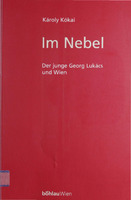
Im Nebel
Der junge Georg Lukács und Wien
 Download
Abstract
The relationship between the intellectual development of the young Georg Lukacs and the culture of Vienna around the turn of the century was investigated in the research project: Georg Lukacs and Vienna. Because of this the main point of interest was to investigate aspects of his work which stand in relation to Vienna around 1900.
First of all the results of previous research about the theme 'Lukacs and Vienna' were held onto. After this, the methodical procedure from cultural studies about the turn of the century, which are treated as the standard works in this field, we re sketched out and the methods for contemporary works were laid down. The relevant biographical facts were laid out in two chapters about his life and his education - with special attention being paid to the question of his introduction to the problems of contemporary Austrian philosophy. The effect of Rudolf Kassner on Lukacs thoughts around 1910 seems to be very important. Lukacs' literature critical texts on modern Austrian drama especially the literature of Arthur Schnitzler and Richard Beer-Hofmann play a central role. The theories, which are developed in these texts, were made more precise in a discussion with Mihaly Babits as well as in the text: Aesthetic Culture. Following this Lukacs' aesthetical Heidelberg writings, which are relevant to the investigation of this project, were analyzed. The insight into the theories, which show up in Lukacs' texts, which was won in the research project through the aforementioned writings was then deepened with consideration to the Jewish Question as well as with an analysis of the concepts of liberalism, culture, and the Modern. At the same time Lukacs' activities were placed in the context of Central Europe. In addition the question was answered: what meaning did the relationship between Lukacs and Vienna have for his later development.
The result of the project is that insight into Georg Lukacs must be viewed in the context of modernity and Central Europe, in order to understand his activity and, in a very concrete way, in order to understand his individual texts. If one doesn't take his contradictory relationship to Vienna around 1900 and to the Modern and Central Europe into account he remains a confused solitary person. Afurther and perhaps even more important result is: When one places Lukacs in the relation of these aforementioned intellectual-historical appearances, these appearances themselves win on dimensions, which first make their understanding possible. Im Forschungsprojekt Georg Lukács und Wien wurde das Verhältnis zwischen der intellektuellen Entwicklung des jungen Georg Lukács und der Kultur der Wiener Jahrhundertwende untersucht. Schwerpunkt war es daher, Lukács' Tätigkeit nach Aspekten zu untersuchen, welche mit der Wiener Kultur um 1900 in Zusammenhang stehen.
Als erstes wurde das über das Thema. 'Lukács und Wien' in der bisherigen Forschung Gesagte festgehalten. Es wurde anschließend das methodische Vorgehen der als Standardwerke geltenden Kulturstudien über die Wiener Jahrhundertwende skizziert und die Methode der vorliegenden Arbeit bestimmt. Die relevanten biographischen Fakten wurden in den zwei Kapiteln über Lukács' Leben und über seine Ausbildung mit Schwerpunkt auf der Frage nach der Vermittlung der Probleme der zeitgenössischen österreichischen Philosophie an ihn - festgehalten. Wesentlich erscheint die Wirkung von Rudolf Kassner auf Lukács' Denken um 1910 zu sein. Eine zentrale Stelle nehmen Lukács' literaturkritische Texte über das moderne österreichische Drama und insbesondere über die Literatur von Arthur Schnitzler und Richard Beer-Hofmann ein. Die in diesen Texten entwickelten Theorien wurden von Lukács in einer Diskussion mit Mihály Babits bzw. im Text Ästhetische Kultur präzisiert. Anschliegend wurden die für die Fragestellung des Projekts relevanten Thesen von Lukács' Heidelberger ästhetischen Schriften analysiert. Die Einsicht in die in Lukács-Texten erscheinenden Theorien, welche im Forschungsprojekt mit den soeben aufgezählten Schritten gewonnen worden ist, wurde mit Überlegungen zur 'jüdischen Frage' bzw. mit der Analyse der Begriffe 'Liberalismus', 'Kultur' und 'Moderne' vertieft. Gleichzeitig wurde Lukács' Tätigkeit in den Kontext von 'Mitteleuropa' gesetzt. Abschließend wurde die Frage beantwortet, welche Bedeutung Lukács' Verhältnis zu Wien für seine weitere Entwicklung hatte.
Ergebnis des Projektes ist die Einsicht, daß Georg Lukács im Kontext von Modernität und Mitteleuropa betrachtet werden muß, um seine Tätigkeit, und auch ganz konkret seine einzelnen Texte verstehen zu können. Berücksichtigt man sein widersprüchliches Verhältnis zu Wien um 1900, zur Moderne und zu Mitteleuropa nicht, bleibt er ein verirrter Einzelner. Ein weiteres, und vielleicht noch bedeutenderes Ergebnis ist: Stellt man Lukács in den Zusammenhang mit jenen geistesgeschichtlichen. Erscheinungen, gewinnen diese Erscheinungen selbst an Dimensionen, welche ihr Verstehen erst ermöglichen.
Keywords
Georg Lukacs; Vienna around 1900; Ästhetik; Impressionismus; Österreich; Philosophie; Ungarn; WienDOI
10.26530/oapen_437218OCN
1030813504Publication date and place
Wien; München, 2002Grantor
Imprint
BöhlauClassification
History