
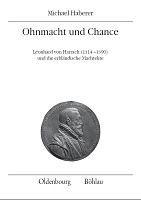
Ohnmacht und Chance
Leonhard von Harrach (1514–1590) und die erbländische Machtelite
 Download
Abstract
This study takes as its point of departure the diet in the summer of the year 1579 in Vienna. Leonhard von Harrach, Privy Councellor of Emperor Rudolf II, negotiated with leaders of the oppositional protestant nobility, who wanted to push through freedom of religious confession in the landesherrlichen cities and market towns in Lower Austria. Analysis of Harrachs's connections to opposition, his scope of action as a member of the government, councellor and mentor of the young, Spanish-catholic oriented Kaiser, professional court politician, nobleman, leader of an Austrian power elite, head of the 'House of Harrach' and a Catholic interested in reaching reconciliation with the protestants, can show the special structures of this conflict. The historiographic basis had largely to be assembled from scratch since, e.g., in recorded histories and chronics very little mention is made of an Austrian power elite within the Habsburg monarchy of the 16th century, which consisted of land-owning noblemen. The existence of this power elite has considerable consequences in gaining a proper understanding of the 'dualism' of Ständestaat as a complex dualistic system of political cooperation in the Habsburg monarchy. This power elite of functionaries from the lower nobility had a strong position in court and administration and also in estates in the Eastern hereditary lands of the Habsburgs. Noble families such as the Roggendorf, Jörger, Hoffmann, Windischgrätz or Khevenhüller, all in the same social network as Harrach, were among the most prominent families to profit from the more central organization of the state and at the same time they produced the most important leaders of the protestant opposition in Vienna and Graz. Although the conflict culture of the dualistic system wasn't strong enough against confessional polarization, the cooperation of the Habsburg dynasty with the court-oriented nobility from the provinces of the hereditary lands proved to be such a successful model of governmental organization that in the Austrian-Bohemian 'Dyarchy' it was continued on a larger scale. Skills of power elite made it possible to Harrach and his friend and relative Jörger, leader of the opposition, to employ a form of crisis management to moderate the oppositions after 1580. But the polarization of religious confessions had destroyed the Irenic of Harrach. His initiation into the Spanish-catholic Habsburg Order of the Golden Fleece gave the decisive impulse, to take on, along with the Archduke Ernst, the overall direction of moderate, but compulsory re-Catholization of the Lower-Austrian cities and market towns, organized by Melchior Khlesl, official of the Bishopric Passau in Vienna. Ausgangspunkt der Untersuchung ist das konfliktreiche Landtagsgeschehen im Sommer des Jahres 1579 in Wien. Der kaiserliche Ratgeber Leonhard von Harrach verhandelte mit den Köpfen des opponierenden protestantischen Adels, der gegen Kaiser Rudolf II. die Glaubensfreiheit für die landesherrlichen Städte und Märkte in Niederösterreich durchsetzen wollte. Die Analyse der Beziehungen Harrachs zu den Opponenten, sowie seines Handlungsspielraums als Mitglied der Regierung, Ratgeber und Mentor eines jungen, spanisch-katholisch orientierten Kaisers, höfischer Berufspolitiker, landsässiger Adliger, Autorität einer erbländischen Machtelite, Chef des Hauses Harrach und um Ausgleich bemühter Katholik ermöglicht, die Spezifik des Konflikts zu entwickeln. Die historiografische Basis dieser Handlungsfelder musste teils von Grund auf erarbeitet werden, da bspw. in der Geschichtsschreibung eine Machtelite aus landsässigen Adligen in der Habsburgermonarchie des 16. Jahrhunderts nicht existiert. Deren Existenz verändert das Verständnis von ständestaatlichem "Dualismus" hin zu einem komplexen dualistischen System, in dem eine "staatliche", gewinnorientierte Funktionselite aus dem landsässigen Niederadel der niederösterreichischen Länder im Herrschaftsapparat und in den Landständen dominiert. Adelsgeschlechter wie die Roggendorf, Jörger, Hoffmann, Windischgrätz oder Khevenhüller, die alle über ein verwandtschaftliches Netzwerk mit Harrach verbunden waren, gehörten zu den herausragenden Profiteuren der Staatsbildung und brachten gleichzeitig die bedeutendsten Führer der protestantischen Opposition in Wien und Graz hervor. Obwohl die Konfliktkultur des dualistischen Systems der Konfessionalisierung nicht gewachsen war, erwies sich die Kooperation der Dynastie mit den hoforientierten Landleuten der Erbländer im 16. Jahrhundert als staatsgeschichtliches Erfolgsmodell, das in der österreichisch-böhmischen Aristokratie der Dyarchie in größerem Stil fortgesetzt wurde. Die Stärken dieser Machtelite ermöglichten Harrach und dem Oppositionsführer Jörger nach 1580 eine Art Krisenmanagement. Allerdings litt unter der zunehmenden Polarisierung die Irenik des Kaiserberaters Harrach. Die Aufnahme in den spanisch-katholischen habsburgischen Hausorden vom Goldenen Vlies gab den entscheidenden Impuls, um zusammen mit Statthalter Erzherzog Ernst die Federführung in einer moderaten, aber zwangsweisen Rekatholisierung der niederösterreichischen Städte und Märkte, die vom Passauer Offizial Melchior Khlesl organisiert wurde, zu übernehmen.
Keywords
Leonhard von Harrach (1514 - 1590); Aristocratic Power Elite; Noble Estates; Austria; Court and Country; catholic confessionalization; Geheimrat; Habsburg; Protestantismus; Römisch-katholische Kirche; Rudolf II. (HRR); WienDOI
10.26530/oapen_437182ISBN
9783205786801OCN
1030816392Publisher
BrillPublisher website
https://brill.com/Publication date and place
Wien; München, 2011Grantor
Imprint
BöhlauClassification
History