
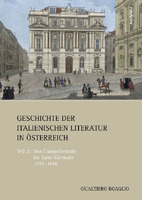
Geschichte der italienischen Literatur in Österreich
Von Campoformido bis Saint-Germain 1797–1918
 Download
Abstract
The present monograph focuses on the history of Italian literature and language in Austria's Habsburg past, covering the period from the Peace of Campoformido between Napoleon and Francis II in 1797 to the end of the Habsburg monarchy in 1918. The study reveals that Italian court poetry was amazingly alive in the 19th century as it gradually had been adapted to the changes in the fields of politics, society, and the press. After analyzing the end of the golden era of Italian poetry in Austria, the author presents Archduchess Maria Beatrice d'Este and her literary circle. She was the last patroness of Italian artists and poets and kept up the old-style tradition of court poetry until her death in 1829. During the 19th century, however, this tradition faced an ever increasing popularization, with Italian language books and instruction getting more and more common. The Italian language was never discriminated against in the Habsburg monarchy. On the contrary, it was even extensively taught at universities because officials with a good command of Italian were needed both in the federal government and in the Italian regions of the monarchy. Moreover, the Habsburgs' language policy favored the publication of quality papers and literary magazines in Italian. The study also deals with Italian school books and anthologies for schools in the Italian parts of the monarchy, which were usually written and published in Vienna. In the last part of this chapter, records of the future Emperor Franz Joseph's Italian instruction are presented and analyzed on the basis of archive materials. Anachronistically, court poetry survived the 1848/1849 revolution and continued until World War I. The Emperor was popularized in jubilee editions, newspapers, and ceremonies, but also in the Italian poetry which was no longer of high quality, but still instrumental in presenting Franz Joseph as the "father of the nation". Der Friede von Campoformido (17.10.1797) zwischen Napoleon und Franz II. ist der Ausgangspunkt dieser Monographie, die auf die Geschichte der italienischen Literatur und Sprache in jenen Länderteilen der Habsburgermonarchie fokussiert ist, die dem heutigen Österreich entsprechen. Der Endpunkt ergibt sich aus dem Zusammenfall der Monarchie im Jahr 1918. Die Studie zeigt, dass sich die Huldigungsdichtung in italienischer Sprache im 19. Jahrhundert in Österreich den neuen Gegebenheiten des Pressemarktes, den veränderten politischen Verhältnissen und den soziopolitischen Entwicklungen angepasst hatte und erstaunlich lebendig war. Nachdem die Gründe und die Modalitäten für das Ende der goldenen Epoche der poetischen Tradition in italienischer Sprache in Österreich beleuchtet werden, widmet sich der Autor der Künstlergruppe um Erzherzogin Maria Beatrice von Este, die in Wien die letzte Gönnerin italienischer Künstler und Dichter wurde und die Tradition der Hofdichtung bis zum ihrem Tod 1829 nach altem Muster pflegte. Diese Tradition ist im 19. Jahrhundert jedoch mit einer fortschreitenden Popularisierung konfrontiert, wobei sich die Sprachlehren des Italienischen und der Sprachunterricht wachsender Beliebtheit erfreuten. Die Sprachpolitik der Habsburgermonarchie stellte das Italienische als Kultursprache nie in Frage. Im Gegenteil, die Behörden förderten das Erlernen der Sprache an den Universitäten, um die Anzahl der sprachkundigen Studenten zu erhöhen, die später als Beamte in der Zentralverwaltung wie auch in den italienischen Kronländern eingesetzt werden konnten. Außerdem begünstigte die Sprachpolitik das rege Erscheinen von anspruchsvollen Zeitungen und literarischen Zeitschriften in italienischer Sprache. Da in den italienischen Kronländern der Unterricht in Italienisch erfolgte, behandelt die Studie auch italienische Schulbücher und literarische Schulanthologien, die in Wien gedruckt und meistens auch verfasst wurden. Im letzten Teil dieses Abschnittes wird aufgrund zahlreicher Archivmaterialien der Italienischunterricht des zukünftigen Kaisers Franz Joseph dargestellt und analytisch untersucht. Die Huldigungsdichtung überlebte die Revolutionsjahre 1848/1849 und setzte sich anachronistisch bis zum Ersten Weltkrieg fort. Die unaufhaltsame Popularisierung der Kaiserfigur fand in unzähligen Prunkwerken zu den Herrscherjubiläen, in Zeitungen, Festen aber auch durch italienische Dichtung statt, die zwar keinen hohen poetischen Wert mehr hatte, doch zur Stilisierung Franz Josephs als Vater der Nation beitrug.
Keywords
Italian literature; Italian language; 19th Century; Court Poetry; Language politics; Habsburg Monarchy; Italien; Italienische Sprache; WienDOI
10.26530/oapen_437165OCN
1030815008Publisher
BrillPublisher website
https://brill.com/Publication date and place
2012Grantor
Imprint
BöhlauClassification
Biography, Literature and Literary studies