
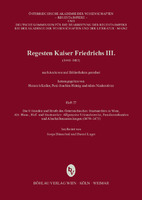
Regesten Kaiser Friedrichs III. (1440-1493)
Die Urkunden und Briefe des Österreichischen Staatsarchives in Wien (1470-1475)
 Download
Abstract
As a result of the death of Duke Charles the Bold of Burgundy and the marriage of his only daughter Mary to Maximilian, the heir of Emperor Frederick III, the economically and culturally prospering lands of Flanders and Brabant became hereditary possessions of the Habsburgs. With this, the foundations for the Habsburgs's hegemony were laid. This dynastic project was for about 10 years (1467-1477) in the spotlight of Emperor Frederick's III diplomatic efforts and that with mixed results. Many documents regarding those negotiations are preserved in the Habsburg "Hausarchiv", now the "Haus-, Hof- und Staatsarchiv" in Vienna. Documents only up to the year 1469 have been published in the "Regesta Imperii - Regesten Friedrichs III." so far. Therefore, in the present publication the systematic collection and registration of charters as well as letters of this important emperor is continued up to the year 1475. As a fundamental edition of sources this publication provides a basis for further research questions concerning the late Middle Ages. The presented material serves as a foundation for studies of political communication in the late Middle Ages, e.g. the relationship between Emperor Frederick III and Duke Charles of Burgundy. The material can provide a basis for a study of the differences and similarities of the diplomacy of two differently developed cultural spheres in the late Middle Ages. Additionally, the formal and compositional analyses of diplomatic writings provide information about the various media of diplomatic communication, the objectives, possibilities and success of diplomatic efforts. An investigation of the actors occurring in these areas can reveal the institutional structure, which enabled the development of networks of aristocratic, civic and legally trained elites. Another basic topic of the provided documents is Emperor Frederick's III territorial activity especially in the years 1470 to 1473, when the emperor primarily stayed in his hereditary lands. There he was faced with areas of conflict clearly represented in the sources. Frederick's definition of his role as the head of the Habsburg house is illustrated by his diplomatic relationship to his cousin Sigmund. Among many other topics, also Frederick's role as the supreme judge of the empire becomes evident in the present sources, especially by judicial summons and judgments of the "Kammergericht" (supreme court), which was pledged to Archbishop Adolf of Mainz at that time. Als Folge des Todes von Herzog Karl dem Kühnen von Burgund und der Ehe seiner einzigen Tochter Maria mit Maximilian, dem Erben Kaiser Friedrichs III., wurden die wirtschaftlich und kulturell prosperierenden Länder Flandern und Brabant Teil der habsburgischen Erblande, wodurch die Basis für den Aufstieg des Hauses Habsburg zur europäischen Großmacht begründet wurde. Dieses dynastische Projekt stand mit wechselndem Erfolg für etwa 10 Jahre (1467-1477) im Mittelpunkt der diplomatischen Bemühungen Kaiser Friedrichs III. Zahlreiche Quellen zu diesen Verhandlungen werden im ehemaligen habsburgischen Hausarchiv, dem heutigen Haus-, Hof- und Staatsarchiv zu Wien aufbewahrt. Bislang wurden lediglich Dokumente bis zum Jahr 1469 im Rahmen der "Regesta Imperii - Regesten Kaiser Friedrichs III." veröffentlicht. Die vorliegende Publikation setzt dieses systematische Sammlung und Regestierung von Urkunden und Briefen dieses bedeutenden Kaisers bis zum Jahr 1475 fort. Als grundlegende Quellenedition legt sie die Basis für weitere Forschungsfragen zum späten Mittelalter. So bietet das vorgelegte Material unter anderem Grundlagen zu Forschungen auf dem Gebiet der politischen Kommunikation im Spätmittelalter, so etwa für Studien zu den Beziehungen zwischen Kaiser Friedrich III. und Herzog Karl von Burgund. Das Material kann etwa als Basis für eine Untersuchung zu den Differenzen und Ähnlichkeiten der Diplomatie zweier unterschiedlich entwickelten Kultursphären des spätmittelalterlichen Europas dienen. Daneben bietet die formale und inhaltliche Analyse von diplomatischen Schreiben Informationen zu den unterschiedlichen Medien der diplomatischen Kommunikation, über Ziele, Möglichkeiten und Erfolg von diplomatischen Bemühungen. Eine Analyse der in den Quellen genannten, handelnden Personen erhellt die institutionelle Struktur, welche die Entwicklung von Netzwerken aristokratischer, bürgerlicher und rechtskundiger Eliten ermöglichte. Ein weiterer Schwerpunkt des Quellenmaterials bildet die landesfürstliche Aktivität Kaiser Friedrichs III., besonders in den Jahren 1470 bis 1473, in denen sich der Kaiser vorrangig in seinen Erblanden aufhielt und dort mit zahlreichen Konfliktfeldern konfrontiert war, die in den Regesten deutlich werden. Friedrichs Definition seiner Stellung als Haupt des Hauses Habsburg wird im Zuge der diplomatischen Beziehungen zu seinem Vetter Sigmund verdeutlicht. Neben vielen weiteren Themen tritt auch Friedrichs Funktion als oberster Gerichtsherr des Reiches in den Quellen zu Tage. Hier sind vor allem zahlreiche richterliche Ladungen und Urteile des Kammergerichts zu nennen, welches in dem behandelten Zeitraum an Erzbischof Adolf von Mainz verpfändet war.
Keywords
late middle age; social network; communication; diplomacy; Emperor Frederick III; Duke Charles the Bold of Burgundy; Lehnswesen; Perg; Urkunde; Wien; ZehntDOI
10.26530/oapen_437164ISBN
9783205787075OCN
1030813988Publisher
BrillPublisher website
https://brill.com/Publication date and place
2012Grantor
Imprint
BöhlauClassification
History