
"... allerlei für die Nationalbibliothek zu ergattern..."
Eine österreichische Institution in der NS-Zeit
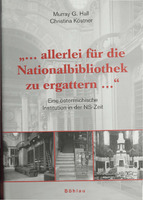
 Download
Abstract
When Austria was annexed by Hitler Germany in March 1938, the National Library in Vienna was not only the biggest scientific library in the country, it was now the third largest in the German Reich. Its status among and influence on the scholarly libraries in the Reich was considerably enhanced by one person during the Nazi period, namely the newly-appointed director-general Dr. Paul Heigl, a fervent National socialist, Acquisitions by the Library during the years 1938 to 1945 are a key focal point of this history, and Heigl played both an active and significant role in the process of book looting in the interest of the National Library.
The Library may well have regarded itself in the inter-war years as being „apolitical“ – and house historians have tended to reinforce this image – but this does not stand up to closer scrutiny even during the political period of the „Corporate State“ und Dollfuss and Schuschnigg, let alone during the time of national socialist rule in Austria. The study breaks with the previos taboos and presents the essentially political role of the Library both before and after March 1938 by investigating its involvement in the crimes of the Nazi regime. But the study does not only concentrate on acquisitions made through improper means, it also attempts to capture some of the atmosphere of a major library under the NS-regime and in war-time.
The examination also sees itself as a contribution to the hitherto neglected history of libraries in Austria in the Nazi period in general and of church and official libraries in particular. It might be noted that Paul Heigl was not only in charge of scholary libraries in south-eastern Europe following the German invasion of Yugoslavia in April 1941, he was also a library consultant for local Nazi officials and had considerable sway in forging library policy. Our study discusses a number of chapters in the Library ´s history during the Nazi period which have so far been absent from official histories, primarily those which implicate the Library and point to the vast and varied acquisitions. The main chapter focusses on the development and acquisitions of the Library´s many collections from 1938 o 1945, chiefly on the basis of library records and files, and attempts to describe not only the looting, but also fate of stolen books, libraries and collections immediately after World War Two and on up to the present day. And, as the case may be, their subsequent restitution over the past few years as a consequence of the Art Restitution Law of 1998. Name and subject indices are intended to make the information in thistory more easily accessible. Die Nationalbibliothek in Wien war zum Zeitpunkt des "Anschlusses" Österreichs an das Deutsche Reich im März 1938 nicht die größte wissenschaftliche Bibliothek im Lande, sondern nunmehr die drittgrößte im Deutschen Reich. Ihre Stellung bzw. Ihr Einfluss als Institution in der Bibliothekslandschaft wurde durch die Person des neuen Generaldirektors Dr. Paul Heigl noch verstärkt. Erwerbungen der Nationalbibliothek in den Jahren 1938 bis 1945 aus unterschiedlicher Provenienz und unter unterschiedlichsten Umständen sind ein Schwerpunkt der vorliegenden Geschichte, durch die sich die Person und die Tätigkeit Heigls wie ein roter Faden zieht. Es ist nämlich nicht schwierig, dessen persönliche Einflussnahme bei Enteignungen, die die Geschichte der Bibliothek in der NS-Zeit prägten, nachzuweisen.
Nach ihrem Selbstbild mag die Nationalbibliothek stets "unpolitisch" gewesen sein, doch darf man nicht übersehen bzw. unterschätzen, dass sie im Zeitraum, der hier behandelt wird, drei verschiedenen Staatsformen diente. Da die Wirklichkeit von diesem Selbstbildnis so starkt abweicht, werden die bisherigen Selbstdarstellungen von Seiten der Bibliothek nicht nur Schlusswort stark in Zweifel gezogen, sondern im Laufe der Arbeit kontinuierlich hinterfragt. Die politische Instrumentalisierung der NB zeigt sich spätestens in der Zeit des Ständestaats in den 30er Jahren. Die vorliegende Arbeit räumt mit der Tabuisierung der eigenen Geschichte der Nationalbibliothek bzw. dem Verschweigen der Verstrickung in NS-Verbrechen in offiziellen Publikationen seit dem Ende des Zweiten Weltkriegs auf und schildert die aktive Rolle, die die Bibliothek bei Erwerbungen spielte. Diese Geschichte will nicht nur auf unrechtmäßige Erwerbungen fokussieren, sondern auch den Versuch unternehmen, den Alltag in der Bibliothek in der NS-Zeit einzufangen.
Diese Geschichte versteht sich auch als Beitrag zur eher stiefmütterlich behandelten Geschichte des Bibliothekswesens ganz allgemein in Österreich in den Jahren 1938 bis 1945. In einer seiner vielen Funktionen war Paul Heigl nämlich bei der Auflösung von Amts- und Stiftsbibliotheken als Berater tätig, und somit wird das Schicksal dieser Büchereien erstmals ausführlich beleuchtet. Nicht unwesentlich für die Geschichte der NB ist beispielsweise auch noch, dass Paul Heigl - nach dem Überfall auf Belgrad - für die wissenschaftlichen Bibliotheken in Südosteuropa offiziell zuständig wurde. Auch diese Funktion nützte die NB, insofern als sie zu neuen Bücherzuwächsen führte.
Im umfangmäßig gesehenen Hauptkapitel (Die Sammlungen der NB) wird anhand von Archivunterlagen, die primär aus der Nationalbibliothek selber stammen, in Form von Falldarstellungen auf die einzelnen geraubten Bücherbestände ausführlich eingegangen. Somit sind die Bemühungen der Nationalbibliothek - sowohl in den Nachkriegsjahren als auch in jüngster Zeit - um das Ausfindigmachen von geraubten Büchern in den eigenen Bibliotheksbeständen und die Zuordnung zu Vorbesitzern ebenfalls ein wesenlicher Aspekt dieser Darstellung.
Die Arbeit wird durch zwei Register -ein Namen- und ein Sachregister - erschlossen.
Keywords
National Library; Book Looting; Library History; National Socialism; 1938 - 1945; Berlin; Bibliothek; Geheime Staatspolizei; Österreichische Nationalbibliothek; WienDOI
10.26530/oapen_437148OCN
1066502906Publisher
BrillPublisher website
https://brill.com/Publication date and place
2006Grantor
Imprint
BöhlauClassification
History