
Logo Oapen
  • Join
    • Deposit
    • For Librarians
    • For Publishers
    • For Researchers
    • Funders
    • Resources
    • OAPEN
        View Item 
        •   OAPEN Home
        • View Item
        •   OAPEN Home
        • View Item
        JavaScript is disabled for your browser. Some features of this site may not work without it.

        A World of Disorderly Notions

        Quixote and the Logic of Exceptionalism
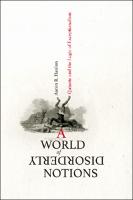
        Thumbnail
        Download PDF Viewer
        Author(s)
        Hanlon, Aaron R.
        Language
        English
        Show full item record
        Abstract
        "From Jonathan Swift to Washington Irving, those looking to propose and justify exceptions to social and political norms turned to Cervantes’s notoriously mad comic hero as a model. A World of Disorderly Notions examines the literary and political effects of Don Quixote, arguing that what makes this iconic character so influential across oceans and cultures is not his madness but his logic. Aaron Hanlon contends that the logic of quixotism is in fact exceptionalism—the strategy of rendering oneself an exception to everyone else’s rules. As British and American societies of the Enlightenment developed the need to question the acceptance of various forms of imperialism and social contract theory—and to explain both the virtues and limitations of revolutions past and ongoing—it was Quixote’s exceptionalism, not his madness, that captured the imaginations of so many writers and statesmen. As a consequence, the eighteenth century witnessed an explosion of imitations of Quixote in fiction and polemical writing, by writers such as Jonathan Swift, Charlotte Lennox, Henry Fielding, and Washington Irving, among others. Combining literary history and political theory, Hanlon clarifies an ongoing and immediately relevant history of exceptionalism, of how states from Golden Age Spain to imperial Britain to the formative United States rendered themselves exceptions so they could act with impunity. In so doing, he tells the story of how Quixote became exceptional."
        URI
        https://library.oapen.org/handle/20.500.12657/41256
        Keywords
        Don Quixote; enlightenment; Jonathan Swift; Washington Irving
        DOI
        10.32881/book3
        ISBN
        9780813942162
        Publisher
        University of Virginia Press
        Publication date and place
        Charlottesville, 2020
        Classification
        Biography, Literature and Literary studies
        Pages
        232
        Rights
        https://creativecommons.org/licenses/by-nc-nd/4.0/
        • Imported or submitted locally

        Browse

        All of OAPENSubjectsPublishersLanguagesCollections

        My Account

        LoginRegister

        Export

        Repository metadata
        Logo Oapen
        • For Librarians
        • For Publishers
        • For Researchers
        • Funders
        • Resources
        • OAPEN

        Newsletter

        • Subscribe to our newsletter
        • view our news archive

        Follow us on

        License

        • If not noted otherwise all contents are available under Attribution 4.0 International (CC BY 4.0)

        Credits

        • logo EU
        • This project received funding from the European Union's Horizon 2020 research and innovation programme under grant agreement No 683680, 810640, 871069 and 964352.

        OAPEN is based in the Netherlands, with its registered office in the National Library in The Hague.

        Director: Niels Stern

        Address:
        OAPEN Foundation
        Prins Willem-Alexanderhof 5
        2595 BE The Hague
        Postal address:
        OAPEN Foundation
        P.O. Box 90407
        2509 LK The Hague

        Websites:
        OAPEN Home: www.oapen.org
        OAPEN Library: library.oapen.org
        DOAB: www.doabooks.org


        Export search results

        The export option will allow you to export the current search results of the entered query to a file. Differen formats are available for download. To export the items, click on the button corresponding with the preferred download format.

        A logged-in user can export up to 15000 items. If you're not logged in, you can export no more than 500 items.

        To select a subset of the search results, click "Selective Export" button and make a selection of the items you want to export. The amount of items that can be exported at once is similarly restricted as the full export.

        After making a selection, click one of the export format buttons. The amount of items that will be exported is indicated in the bubble next to export format.