
Logo Oapen
  • Join
    • Deposit
    • For Librarians
    • For Publishers
    • For Researchers
    • Funders
    • Resources
    • OAPEN
        View Item 
        •   OAPEN Home
        • View Item
        •   OAPEN Home
        • View Item
        JavaScript is disabled for your browser. Some features of this site may not work without it.

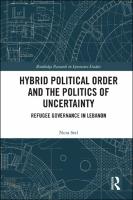
        Hybrid Political Order and the Politics of Uncertainty

        Refugee Governance in Lebanon
        Thumbnail
        Download PDF Viewer
        Author(s)
        Stel, Nora
        Language
        English
        Show full item record
        Abstract
        Lebanon hosts the highest number of refugees per capita worldwide and is central to European policies of outsourcing migration management. Hybrid Political Order and the Politics of Uncertainty is the first book to critically and comprehensively explore the parallels between the country’s engagement with the recent Syrian refugee influx and the more protracted Palestinian presence. Drawing on fieldwork, qualitative case-studies, and critical policy analysis, it questions the dominant idea that the haphazardness, inconsistency, and fragmentation of refugee governance are only the result of forced displacement or host state fragility and the related capacity problems. It demonstrates that the endemic ambiguity that determines refugee governance also results from a lack of political will to create coherent and comprehensive rules of engagement to address refugee ‘crises.’ Building on emerging literatures in the fields of critical refugee studies, hybrid governance, and ignorance studies, it proposes an innovative conceptual framework to capture the spatial, temporal, and procedural dimensions of the uncertainty that refugees face and to tease out the strategic components of the reproduction and extension of such informality, liminality, and exceptionalism. In developing the notion of a ‘politics of uncertainty,’ ambiguity is explored as a component of a governmentality that enables the control, exploitation, and expulsion of refugees.
        URI
        https://library.oapen.org/handle/20.500.12657/45751
        Keywords
        Society and culture: general; Sociology
        DOI
        10.4324/9780429434716
        Publication date and place
        2020
        Imprint
        Routledge
        Series
        Routledge Research in Ignorance Studies,
        Classification
        Society and culture: general
        Sociology
        Pages
        264
        Chapters in this book
        • Chapter Introduction Institutional Ambiguity and the Politics of Uncertainty
        Rights
        All rights reserved
        • Imported or submitted locally

        Browse

        All of OAPENSubjectsPublishersLanguagesCollections

        My Account

        LoginRegister

        Export

        Repository metadata
        Logo Oapen
        • For Librarians
        • For Publishers
        • For Researchers
        • Funders
        • Resources
        • OAPEN

        Newsletter

        • Subscribe to our newsletter
        • view our news archive

        Follow us on

        License

        • If not noted otherwise all contents are available under Attribution 4.0 International (CC BY 4.0)

        Credits

        • logo EU
        • This project received funding from the European Union's Horizon 2020 research and innovation programme under grant agreement No 683680, 810640, 871069 and 964352.

        OAPEN is based in the Netherlands, with its registered office in the National Library in The Hague.

        Director: Niels Stern

        Address:
        OAPEN Foundation
        Prins Willem-Alexanderhof 5
        2595 BE The Hague
        Postal address:
        OAPEN Foundation
        P.O. Box 90407
        2509 LK The Hague

        Websites:
        OAPEN Home: www.oapen.org
        OAPEN Library: library.oapen.org
        DOAB: www.doabooks.org


        Export search results

        The export option will allow you to export the current search results of the entered query to a file. Differen formats are available for download. To export the items, click on the button corresponding with the preferred download format.

        A logged-in user can export up to 15000 items. If you're not logged in, you can export no more than 500 items.

        To select a subset of the search results, click "Selective Export" button and make a selection of the items you want to export. The amount of items that can be exported at once is similarly restricted as the full export.

        After making a selection, click one of the export format buttons. The amount of items that will be exported is indicated in the bubble next to export format.