Logo Oapen
  • Join
    • Deposit
    • For Librarians
    • For Publishers
    • For Researchers
    • Funders
    • Resources
    • OAPEN
        View Item 
        •   OAPEN Home
        • View Item
        •   OAPEN Home
        • View Item
        JavaScript is disabled for your browser. Some features of this site may not work without it.

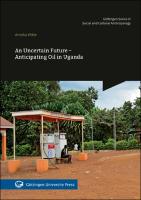
        An Uncertain Future

        Anticipating Oil in Uganda
        Thumbnail
        Download PDF Viewer
        Web Shop
        Author(s)
        Witte, Annika,
        Collection
        AG Universitätsverlage
        Language
        English
        Show full item record
        Abstract
        The discovery of oil in Uganda in 2006 ushered in an oil-age era with new prospects of unforeseen riches. However, after an initial exploration boom developments stalled. Unlike other countries with major oil discoveries, Uganda has been slow in developing its oil. In fact, over ten years after the first discoveries, there is still no oil. During the time of the research for this book between 2012 and 2015, Uganda’s oil had not yet fully materialised but was becoming. The overarching characteristic of this research project was waiting for the big changes to come: a waiting characterised by indeterminacy. There is a timeline but every year it gets expanded and in 2018 having oil still seems to belong to an uncertain future. This book looks at the waiting period as a time of not-yet-ness and describes the practices of future- and resource-making in Uganda. How did Ugandans handle the new resource wealth and how did they imagine their future with oil to be? This ethnography is concerned with Uganda’s oil and the way Ugandans anticipated different futures with it: promising futures of wealth and development and disturbing futures of destruction and suffering. The book works out how uncertainty was an underlying feature of these anticipations and how risks and risk discourses shaped the imaginations of possible futures. Much of the talk around the oil involved the dichotomy of blessing or curse and it was not clear, which one the oil would be. Rather than adding another assessment of what the future with oil will be like, this book describes the predictions and prophesies as an essential part of how resources are being made. This ethnography shows how various actors in Uganda, from the state, the oil industry, the civil society, and the extractive communities, have tried to negotiate their position in the oil arena. Annika Witte argues in this book that by establishing their risks and using them as power resources actors can influence the becoming of oil as a resource and their own place in a petro-future. The book offers one of the first ethnographic accounts of Uganda’s oil and the negotiations that took place in an oil state to be.
        URI
        http://library.oapen.org/handle/20.500.12657/29600
        https://library.oapen.org/handle/20.500.12657/47784
        Keywords
        Uganda; oil; ethnography; Civil society; Oil Region; Petroleum industry; Resource curse; Tullow
        DOI
        10.17875/gup2018-1090
        ISBN
        9783863953607
        OCN
        1051778319
        Publisher
        Universitätsverlag Göttingen
        Publication date and place
        2018
        Classification
        Society & social sciences
        Public remark
        Relevant Wikipedia pages: Civil society - https://en.wikipedia.org/wiki/Civil_society; Oil Region - https://en.wikipedia.org/wiki/Oil_Region; Petroleum industry - https://en.wikipedia.org/wiki/Petroleum_industry; Resource curse - https://en.wikipedia.org/wiki/Resource_curse; Tullow - https://en.wikipedia.org/wiki/Tullow; Uganda - https://en.wikipedia.org/wiki/Uganda
        Rights
        http://creativecommons.org/licenses/by-sa/4.0/deed.de
        • Imported or submitted locally

        Browse

        All of OAPENSubjectsPublishersLanguagesCollections

        My Account

        LoginRegister

        Export

        Repository metadata
        Logo Oapen
        • For Librarians
        • For Publishers
        • For Researchers
        • Funders
        • Resources
        • OAPEN

        Newsletter

        • Subscribe to our newsletter
        • view our news archive

        Follow us on

        License

        • If not noted otherwise all contents are available under Attribution 4.0 International (CC BY 4.0)

        Credits

        • logo EU
        • This project received funding from the European Union's Horizon 2020 research and innovation programme under grant agreement No 683680, 810640, 871069 and 964352.

        OAPEN is based in the Netherlands, with its registered office in the National Library in The Hague.

        Director: Niels Stern

        Address:
        OAPEN Foundation
        Prins Willem-Alexanderhof 5
        2595 BE The Hague
        Postal address:
        OAPEN Foundation
        P.O. Box 90407
        2509 LK The Hague

        Websites:
        OAPEN Home: www.oapen.org
        OAPEN Library: library.oapen.org
        DOAB: www.doabooks.org


        Export search results

        The export option will allow you to export the current search results of the entered query to a file. Differen formats are available for download. To export the items, click on the button corresponding with the preferred download format.

        A logged-in user can export up to 15000 items. If you're not logged in, you can export no more than 500 items.

        To select a subset of the search results, click "Selective Export" button and make a selection of the items you want to export. The amount of items that can be exported at once is similarly restricted as the full export.

        After making a selection, click one of the export format buttons. The amount of items that will be exported is indicated in the bubble next to export format.