
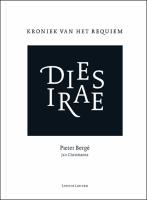
Dies irae
Kroniek van het requiem
 Download
Abstract
The requiem (or the death mass) is one of the oldest and longest surviving genres in Western music history. For hundreds of years it only existed in its original Gregorian guise, but from about 1450 many great composers were inspired to write of masterly new death masses Dies Irae introduces the reader to these masterpieces in an accessible way, without any prior musical knowledge being required.
After an introduction to the meaning and structure of the text and music of the ancient Latin Mass for the Dead, a chronicle in three parts follows that guides the reader through the history of the requiem. In separate chapters, all the major and well-known requiems (including by Mozart, Brahms, Verdi, Fauré, Britten and Webber), as well as some less popular but equally poignant works (such as the requiems by Ockeghem, Schütz, Weill, Ligeti, Stravinsky and Zimmermann).
Each requiem is discussed according to a fixed pattern, so that the reader can freely browse through different periods and compositions: first each work is situated music-historically, followed by a short discussion of each part separately. By linking the discussions to one reference recording per work, the reader can immediately test the explanation against listening practice.
Under the direction of Pieter Bergé, and with the cooperation of Jan Christiaens, all contributions to 'Dies Irae. Chronicle of the Requiem' written by authors who are affiliated with the Musicology research unit of KU Leuven as teachers, researchers or alumnus. Het requiem (of de dodenmis) is een van de oudste en langst overlevende genres uit de westerse muziekgeschiedenis. Honderden jaren heeft het enkel bestaan in zijn oorspronkelijke gregoriaanse gedaante, maar vanaf ca. 1450 hebben heel wat grote componisten zich laten inspireren tot het schrijven van magistrale nieuwe dodenmissen. Dies Irae laat de lezer op toegankelijke wijze kennismaken met deze meesterwerken zonder dat muzikale voorkennis vereist is.
Na een inleiding over de betekenis en structuur van de tekst en muziek van de aloude Latijnse dodenmis, volgt een kroniek in drie delen die de lezer door de geschiedenis van het requiem gidst. In aparte hoofdstukken komen alle grote en bekende requiems aan bod (onder meer van Mozart, Brahms, Verdi, Fauré, Britten en Webber), evenals enkele minder populaire maar minstens even aangrijpende werken (zoals de requiems van Ockeghem, Schütz, Weill, Ligeti, Stravinsky en Zimmermann).
Elk requiem wordt volgens een vast stramien besproken, zodat de lezer vrijelijk kan grasduinen door verschillende perioden en composities: eerst wordt ieder werk muziekhistorisch gesitueerd, daarna volgt een korte bespreking van elk deel afzonderlijk. Door de besprekingen te koppelen aan één referentieopname per werk, kan de lezer de uitleg meteen ook aan de luisterpraktijk toetsen.
Onder de leiding van Pieter Bergé, en met medewerking van Jan Christiaens werden alle bijdragen aan 'Dies Irae. Kroniek van het requiem' geschreven door auteurs die als docent, onderzoeker of alumnus verbonden zijn aan de onderzoekseenheid Musicologie van de KU Leuven.
Keywords
requiem; dodenmis; muziekgeschiedenisDOI
10.11116/9789461664303ISBN
9789461664303, 9789058678805Publisher
Leuven University PressPublisher website
https://lup.be/Publication date and place
Leuven, 2021Classification
Theory of music and musicology