Logo Oapen
  • Join
    • Deposit
    • For Librarians
    • For Publishers
    • For Researchers
    • Funders
    • Resources
    • OAPEN
        View Item 
        •   OAPEN Home
        • View Item
        •   OAPEN Home
        • View Item
        JavaScript is disabled for your browser. Some features of this site may not work without it.

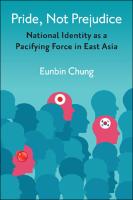
        Pride, Not Prejudice

        External Review of Whole Manuscript

        National Identity as a Pacifying Force in East Asia
        Thumbnail
        Download PDF Viewer
        Web Shop
        Author(s)
        Chung, Eunbin
        Language
        English
        Show full item record
        Abstract
        As shown by China’s relationship to Japan, and Japan’s relationship to South Korea, even growing regional economic interdependencies are not enough to overcome bitter memories grounded in earlier wars, invasions, and periods of colonial domination. Although efforts to ease historical animosity have been made, few have proven to be successful in Northeast Asia. In previous research scholars anticipated an improvement in relations through thick economic interdependence or increased societal contact. In economic terms, however, Japan and China already trade heavily: Japan has emerged as China’s largest trading partner and China as second largest to Japan. Societal contact is already intense, as millions of Chinese, Koreans, and Japanese visit one another’s countries annually as students, tourists, and on business trips. But these developments have not alleviated international distrust and negative perception, or resolved disagreement on what constitutes “adequate reparation” regarding the countries’ painful history. Noticing clashes of strong nationalisms around the world in areas like Northeast Asia, numerous studies have suggested that more peaceful relations are likely only if countries submerge or paper over existing national identities by promoting universalism. Pride, Not Prejudice argues, to the contrary, that affirmation of national identities may be a more effective way to build international cooperation. If each national population reflects on the values of their national identity, trust and positive perception can increase between countries. This idea is consistent with the theoretical foundation that those who have a clear, secure, and content sense of self, in turn, can be more open, evenhanded, and less defensive toward others. In addition, this reduced defensiveness also enhances guilt admission by past “inflictors” of conflict and colonialism. Eunbin Chung borrows the social psychological theory of self-affirmation and applies it to an international context to argue that affirmation of a national identity, or reflecting on what it means to be part of one’s country, can increase trust, guilt recognition, and positive perception between countries.
        URI
        https://library.oapen.org/handle/20.500.12657/52226
        Keywords
        national identity;group-affirmation;national identity affirmation;political psychology;field research
        DOI
        10.3998/mpub.12010257
        ISBN
        9780472902934, 9780472132942, 9780472039050, 9780472129904
        Publisher
        University of Michigan Press
        Publisher website
        https://www.press.umich.edu/
        Publication date and place
        2022
        Classification
        Politics and government
        Diplomacy
        Nationalism
        Pages
        334
        Rights
        https://creativecommons.org/licenses/by-nc-nd/4.0/
        • Imported or submitted locally

        Browse

        All of OAPENSubjectsPublishersLanguagesCollections

        My Account

        LoginRegister

        Export

        Repository metadata
        Logo Oapen
        • For Librarians
        • For Publishers
        • For Researchers
        • Funders
        • Resources
        • OAPEN

        Newsletter

        • Subscribe to our newsletter
        • view our news archive

        Follow us on

        License

        • If not noted otherwise all contents are available under Attribution 4.0 International (CC BY 4.0)

        Credits

        • logo EU
        • This project received funding from the European Union's Horizon 2020 research and innovation programme under grant agreement No 683680, 810640, 871069 and 964352.

        OAPEN is based in the Netherlands, with its registered office in the National Library in The Hague.

        Director: Niels Stern

        Address:
        OAPEN Foundation
        Prins Willem-Alexanderhof 5
        2595 BE The Hague
        Postal address:
        OAPEN Foundation
        P.O. Box 90407
        2509 LK The Hague

        Websites:
        OAPEN Home: www.oapen.org
        OAPEN Library: library.oapen.org
        DOAB: www.doabooks.org


        Export search results

        The export option will allow you to export the current search results of the entered query to a file. Differen formats are available for download. To export the items, click on the button corresponding with the preferred download format.

        A logged-in user can export up to 15000 items. If you're not logged in, you can export no more than 500 items.

        To select a subset of the search results, click "Selective Export" button and make a selection of the items you want to export. The amount of items that can be exported at once is similarly restricted as the full export.

        After making a selection, click one of the export format buttons. The amount of items that will be exported is indicated in the bubble next to export format.