
Logo Oapen
  • Join
    • Deposit
    • For Librarians
    • For Publishers
    • For Researchers
    • Funders
    • Resources
    • OAPEN
        View Item 
        •   OAPEN Home
        • View Item
        •   OAPEN Home
        • View Item
        JavaScript is disabled for your browser. Some features of this site may not work without it.

        A Genealogy of Bamboo Diplomacy

        The Politics of Thai Détente with Russia and China
        Thumbnail
        Download PDF Viewer
        Author(s)
        Poonkham, Jittipat
        Language
        English
        Show full item record
        Abstract
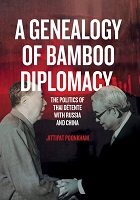
        In 1975, M.R. Kurkrit Pramoj met Mao Zedong, marking the eventual establishment of diplomatic relations and a discursive rupture with the previous narrative of Communist powers as an existential threat. This book critically interrogates the birth of bamboo (bending with the wind) diplomacy and the politics of Thai détente with Russia and China in the long 1970s (1968–80). By 1968, Thailand was encountering discursive anxiety amid the prospect of American retrenchment from the Indo-Pacific region. As such, Thailand developed a new discourse of détente to make sense of the rapidly changing world politics and replace the hegemonic discourse of anticommunism. By doing so, it created a political struggle between the old and new discourses. Jittipat Poonkham also argues that bamboo diplomacy – previously seen as a classic and continual 'tradition' of Thai-style diplomacy – had its origins in Thai détente and has become the metanarrative of Thai diplomacy since then. Based on a genealogical approach and multi‑archival research, this book examines three key episodes of Thai détente: Thanat Khoman (1968–71), M.R. Kukrit Pramoj (1975–76), and General Kriangsak Chomanan (1977–80). This transformation was represented in numerous diplomatic/discursive practices, such as ping‑pong diplomacy, petro‑diplomacy, trade and cultural diplomacy, and normal visits.
        URI
        https://library.oapen.org/handle/20.500.12657/52652
        Keywords
        Thailand; Bamboo Diplomacy; Genealogy; Détente; Communist Powers
        DOI
        10.22459/GBD.2022
        ISBN
        9781760464998, 9781760464998, 9781760464981
        Publisher
        ANU Press
        Publisher website
        https://press.anu.edu.au/
        Publication date and place
        Canberra, 2022
        Classification
        Asian history
        History and Archaeology
        20th century, c 1900 to c 1999
        International relations
        Diplomacy
        Pages
        336
        Rights
        https://creativecommons.org/licenses/by-nc-nd/4.0/
        • Imported or submitted locally

        Browse

        All of OAPENSubjectsPublishersLanguagesCollections

        My Account

        LoginRegister

        Export

        Repository metadata
        Logo Oapen
        • For Librarians
        • For Publishers
        • For Researchers
        • Funders
        • Resources
        • OAPEN

        Newsletter

        • Subscribe to our newsletter
        • view our news archive

        Follow us on

        License

        • If not noted otherwise all contents are available under Attribution 4.0 International (CC BY 4.0)

        Credits

        • logo EU
        • This project received funding from the European Union's Horizon 2020 research and innovation programme under grant agreement No 683680, 810640, 871069 and 964352.

        OAPEN is based in the Netherlands, with its registered office in the National Library in The Hague.

        Director: Niels Stern

        Address:
        OAPEN Foundation
        Prins Willem-Alexanderhof 5
        2595 BE The Hague
        Postal address:
        OAPEN Foundation
        P.O. Box 90407
        2509 LK The Hague

        Websites:
        OAPEN Home: www.oapen.org
        OAPEN Library: library.oapen.org
        DOAB: www.doabooks.org


        Export search results

        The export option will allow you to export the current search results of the entered query to a file. Differen formats are available for download. To export the items, click on the button corresponding with the preferred download format.

        A logged-in user can export up to 15000 items. If you're not logged in, you can export no more than 500 items.

        To select a subset of the search results, click "Selective Export" button and make a selection of the items you want to export. The amount of items that can be exported at once is similarly restricted as the full export.

        After making a selection, click one of the export format buttons. The amount of items that will be exported is indicated in the bubble next to export format.