Logo Oapen
  • Join
    • Deposit
    • For Librarians
    • For Publishers
    • For Researchers
    • Funders
    • Resources
    • OAPEN
        View Item 
        •   OAPEN Home
        • View Item
        •   OAPEN Home
        • View Item
        JavaScript is disabled for your browser. Some features of this site may not work without it.

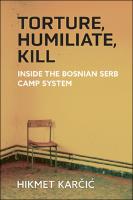
        Torture, Humiliate, Kill

        External Review of Whole Manuscript

        Inside the Bosnian Serb Camp System
        Thumbnail
        Download PDF Viewer
        Author(s)
        Karcic, Hikmet
        Collection
        Knowledge Unlatched (KU)
        Language
        English
        Show full item record
        Abstract
        Half a century after the Holocaust, on European soil, Bosnian Serbs orchestrated a system of concentration camps where they subjected their Bosniak Muslim and Bosnian Croat neighbors to torture, abuse, and killing. Foreign journalists exposed the horrors of the camps in the summer of 1992, sparking worldwide outrage. This exposure, however, did not stop the mass atrocities. Hikmet Karčić shows that the use of camps and detention facilities has been a ubiquitous practice in countless wars and genocides in order to achieve the wartime objectives of perpetrators. Although camps have been used for different strategic purposes, their essential functions are always the same: to inflict torture and lasting trauma on the victims. Torture, Humiliate, Kill develops the author’s collective traumatization theory, which contends that the concentration camps set up by the Bosnian Serb authorities had the primary purpose of inflicting collective trauma on the non-Serb population of Bosnia and Herzegovina. This collective traumatization consisted of excessive use of torture, sexual abuse, humiliation, and killing. The physical and psychological suffering imposed by these methods were seen as a quick and efficient means to establish the Serb “living space.” Karčić argues that this trauma was deliberately intended to deter non-Serbs from ever returning to their pre-war homes. The book centers on multiple examples of experiences at concentration camps in four towns operated by Bosnian Serbs during the war: Prijedor, Bijeljina, Višegrad, and Bileća. Chosen according to their political and geographical position, Karčić demonstrates that these camps were used as tools for the ethno-religious genocidal campaign against non-Serbs. Torture, Humiliate, Kill is a thorough and definitive resource for understanding the function and operation of camps during the Bosnian genocide.
        URI
        https://library.oapen.org/handle/20.500.12657/54072
        Keywords
        Genocide, Holocaust, concentration camps, Bosnia and Herzegovina, Yugoslavia, Serbia, incarceration, detention, killings, mass graves, torture, Bosniaks, Bosnian Muslims, Visegrad, Bijeljina, Bileca, 1992, 1995, refugees, Prijedor, Croatia, mass atrocities
        DOI
        10.3998/mpub.12079875
        ISBN
        9780472902712, 9780472132966, 9780472039043, 9780472129928
        Publisher
        University of Michigan Press
        Publisher website
        https://www.press.umich.edu/
        Publication date and place
        Ann Arbor, 2022
        Grantor
        • Knowledge Unlatched
        Imprint
        University of Michigan Press
        Series
        Ethnic Conflict: Studies in Nationality, Race, and Culture,
        Classification
        Politics and government
        War crimes
        Human rights, civil rights
        European history
        Pages
        276
        Rights
        https://creativecommons.org/licenses/by-nc-nd/4.0/
        • Imported or submitted locally

        Browse

        All of OAPENSubjectsPublishersLanguagesCollections

        My Account

        LoginRegister

        Export

        Repository metadata
        Logo Oapen
        • For Librarians
        • For Publishers
        • For Researchers
        • Funders
        • Resources
        • OAPEN

        Newsletter

        • Subscribe to our newsletter
        • view our news archive

        Follow us on

        License

        • If not noted otherwise all contents are available under Attribution 4.0 International (CC BY 4.0)

        Credits

        • logo EU
        • This project received funding from the European Union's Horizon 2020 research and innovation programme under grant agreement No 683680, 810640, 871069 and 964352.

        OAPEN is based in the Netherlands, with its registered office in the National Library in The Hague.

        Director: Niels Stern

        Address:
        OAPEN Foundation
        Prins Willem-Alexanderhof 5
        2595 BE The Hague
        Postal address:
        OAPEN Foundation
        P.O. Box 90407
        2509 LK The Hague

        Websites:
        OAPEN Home: www.oapen.org
        OAPEN Library: library.oapen.org
        DOAB: www.doabooks.org


        Export search results

        The export option will allow you to export the current search results of the entered query to a file. Differen formats are available for download. To export the items, click on the button corresponding with the preferred download format.

        A logged-in user can export up to 15000 items. If you're not logged in, you can export no more than 500 items.

        To select a subset of the search results, click "Selective Export" button and make a selection of the items you want to export. The amount of items that can be exported at once is similarly restricted as the full export.

        After making a selection, click one of the export format buttons. The amount of items that will be exported is indicated in the bubble next to export format.