
Logo Oapen
  • Join
    • Deposit
    • For Librarians
    • For Publishers
    • For Researchers
    • Funders
    • Resources
    • OAPEN
        View Item 
        •   OAPEN Home
        • View Item
        •   OAPEN Home
        • View Item
        JavaScript is disabled for your browser. Some features of this site may not work without it.

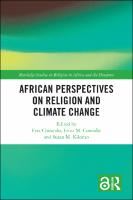
        African Perspectives on Religion and Climate Change

        Proposal review
        Thumbnail
        Download PDF Viewer
        Contributor(s)
        Chitando, Ezra (editor)
        Conradie, Ernst M. (editor)
        Kilonzo, Susan M. (editor)
        Collection
        Knowledge Unlatched (KU); Routledge African Studies 2020 - 2022
        Language
        English
        Show full item record
        Abstract
        This book interrogates the contributions that religious traditions have made to climate change discussions within Africa, whether positive or negative. Drawing on a range of African contexts and religious traditions, the book provides concrete suggestions on how individuals and communities of faith must act in order to address the challenge of climate change. Despite the fact that Africa has contributed relatively little to historic carbon emissions, the continent will be affected disproportionally by the increasing impact of anthropogenic climate change. Contributors to this book provide a range of rich case studies to investigate how religious traditions, such as Christianity, Hinduism, Islam, and indigenous faiths influence the worldviews and actions of their adherents. The chapters also interrogate how the moral authority and leadership provided by religion can be used to respond and adapt to the challenges posed by climate change. Topics covered include risk reduction and resilience, youth movements, indigenous knowledge systems, environmental degradation, gender perspectives, ecological theories, and climate change financing. This book will be of interest to scholars in diverse fields, including religious studies, sociology, political science, climate change, and environmental humanities. It may also benefit practitioners involved in solving community challenges related to climate change. This book interrogates the contributions that religious traditions have made to climate change discussions within Africa, whether positive or negative. Drawing on a range of African contexts and religious traditions, the book provides concrete suggestions on how individuals and communities of faith must act in order to address the challenge of climate change. Despite the fact that Africa has contributed relatively little to historic carbon emissions, the continent will be affected disproportionally by the increasing impact of anthropogenic climate change. Contributors to this book provide a range of rich case studies to investigate how religious traditions such as Christianity, Hinduism, Islam, and indigenous faiths influence the worldviews and actions of their adherents. The chapters also interrogate how the moral authority and leadership provided by religion can be used to respond and adapt to the challenges posed by climate change. Topics covered include risk reduction and resilience, youth movements, indigenous knowledge systems, environmental degradation, gender perspectives, ecological theories, and climate change financing. This book will be of interest to scholars in diverse fields, including religious studies, sociology, political science, climate change and environmental humanities. It may also benefit practitioners involved in solving community challenges related to climate change.
        URI
        https://library.oapen.org/handle/20.500.12657/54326
        Keywords
        christianity; environment; indigenous religion; islam; religious authority
        DOI
        10.4324/9781003147909
        ISBN
        9781000587586, 9780367707712, 9780367616076, 9781003147909
        Publisher
        Taylor & Francis
        Publisher website
        https://taylorandfrancis.com/
        Publication date and place
        2022
        Grantor
        • Knowledge Unlatched
        Imprint
        Routledge
        Series
        Routledge Studies on Religion in Africa and the Diaspora,
        Pages
        254
        Rights
        https://creativecommons.org/licenses/by-nc-nd/4.0/
        • Imported or submitted locally

        Browse

        All of OAPENSubjectsPublishersLanguagesCollections

        My Account

        LoginRegister

        Export

        Repository metadata
        Logo Oapen
        • For Librarians
        • For Publishers
        • For Researchers
        • Funders
        • Resources
        • OAPEN

        Newsletter

        • Subscribe to our newsletter
        • view our news archive

        Follow us on

        License

        • If not noted otherwise all contents are available under Attribution 4.0 International (CC BY 4.0)

        Credits

        • logo EU
        • This project received funding from the European Union's Horizon 2020 research and innovation programme under grant agreement No 683680, 810640, 871069 and 964352.

        OAPEN is based in the Netherlands, with its registered office in the National Library in The Hague.

        Director: Niels Stern

        Address:
        OAPEN Foundation
        Prins Willem-Alexanderhof 5
        2595 BE The Hague
        Postal address:
        OAPEN Foundation
        P.O. Box 90407
        2509 LK The Hague

        Websites:
        OAPEN Home: www.oapen.org
        OAPEN Library: library.oapen.org
        DOAB: www.doabooks.org


        Export search results

        The export option will allow you to export the current search results of the entered query to a file. Differen formats are available for download. To export the items, click on the button corresponding with the preferred download format.

        A logged-in user can export up to 15000 items. If you're not logged in, you can export no more than 500 items.

        To select a subset of the search results, click "Selective Export" button and make a selection of the items you want to export. The amount of items that can be exported at once is similarly restricted as the full export.

        After making a selection, click one of the export format buttons. The amount of items that will be exported is indicated in the bubble next to export format.