
Logo Oapen
  • Join
    • Deposit
    • For Librarians
    • For Publishers
    • For Researchers
    • Funders
    • Resources
    • OAPEN
        View Item 
        •   OAPEN Home
        • View Item
        •   OAPEN Home
        • View Item
        JavaScript is disabled for your browser. Some features of this site may not work without it.

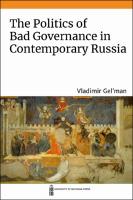
        The Politics of Bad Governance in Contemporary Russia

        External Review of Whole Manuscript
        Thumbnail
        Download PDF Viewer
        Download
        Web Shop
        Author(s)
        Gel’man, Vladimir
        Collection
        Sustainable History Monograph Pilot (SHMP)
        Language
        English
        Show full item record
        Abstract
        In this book, Vladimir Gel’man considers bad governance as a distinctive politico-economic order that is based on a set of formal and informal rules, norms, and practices quite different from those of good governance. Some countries are governed badly intentionally because the political leaders of these countries establish and maintain rules, norms, and practices that serve their own self-interests. Gel’man considers bad governance as a primarily agency-driven rather than structure-induced phenomenon. He addresses the issue of causes and mechanisms of bad governance in Russia and beyond from a different scholarly optics, which is based on a more general rationale of state-building, political regime dynamics, and policy-making. He argues that although these days, bad governance is almost universally perceived as an anomaly, at least in developed countries, in fact human history is largely a history of ineffective and corrupt governments, while the rule of law and decent state regulatory quality are relatively recent matters of modern history, when they emerged as side effects of state-building. Indeed, the picture is quite the opposite: bad governance is the norm, while good governance is an exception. The problem is that most rulers, especially if their time horizons are short and the external constraints on their behavior are not especially binding, tend to govern their domains in a predatory way because of the prevalence of short-term over long-term incentives. Contemporary Russia may be considered as a prime example of this phenomenon. Using an analysis of case studies of political and policy changes in Russia after the Soviet collapse, Gel’man discusses the logic of building and maintenance of politico-economic order of bad governance in Russia and paths of its possible transformation in a theoretical and comparative perspective.
        URI
        https://library.oapen.org/handle/20.500.12657/54679
        Keywords
        government, bad governance, politics, policy-making, authoritarianism, rent-seeking, rule of law, corruption, technocracy, modernization, socio-economic development, state-building, predatory state, state regulations, ineffectiveness of government, pockets of efficiency, post-Communism, policy entrepreneurship, agency, elites, political leadership, Russia
        DOI
        10.3998/mpub.11621795
        ISBN
        9780472902989, 9780472902989, 9780472075621, 9780472055623
        Publisher
        University of Michigan Press
        Publisher website
        https://www.press.umich.edu/
        Publication date and place
        2022
        Pages
        312
        Rights
        https://creativecommons.org/licenses/by-nc-nd/4.0/
        • Imported or submitted locally

        Browse

        All of OAPENSubjectsPublishersLanguagesCollections

        My Account

        LoginRegister

        Export

        Repository metadata
        Logo Oapen
        • For Librarians
        • For Publishers
        • For Researchers
        • Funders
        • Resources
        • OAPEN

        Newsletter

        • Subscribe to our newsletter
        • view our news archive

        Follow us on

        License

        • If not noted otherwise all contents are available under Attribution 4.0 International (CC BY 4.0)

        Credits

        • logo EU
        • This project received funding from the European Union's Horizon 2020 research and innovation programme under grant agreement No 683680, 810640, 871069 and 964352.

        OAPEN is based in the Netherlands, with its registered office in the National Library in The Hague.

        Director: Niels Stern

        Address:
        OAPEN Foundation
        Prins Willem-Alexanderhof 5
        2595 BE The Hague
        Postal address:
        OAPEN Foundation
        P.O. Box 90407
        2509 LK The Hague

        Websites:
        OAPEN Home: www.oapen.org
        OAPEN Library: library.oapen.org
        DOAB: www.doabooks.org


        Export search results

        The export option will allow you to export the current search results of the entered query to a file. Differen formats are available for download. To export the items, click on the button corresponding with the preferred download format.

        A logged-in user can export up to 15000 items. If you're not logged in, you can export no more than 500 items.

        To select a subset of the search results, click "Selective Export" button and make a selection of the items you want to export. The amount of items that can be exported at once is similarly restricted as the full export.

        After making a selection, click one of the export format buttons. The amount of items that will be exported is indicated in the bubble next to export format.