
Logo Oapen
  • Join
    • Deposit
    • For Librarians
    • For Publishers
    • For Researchers
    • Funders
    • Resources
    • OAPEN
        View Item 
        •   OAPEN Home
        • View Item
        •   OAPEN Home
        • View Item
        JavaScript is disabled for your browser. Some features of this site may not work without it.

        The Road to General Intelligence
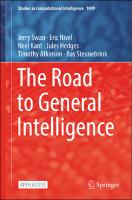
        Thumbnail
        Download PDF Viewer
        Web Shop
        Author(s)
        Swan, Jerry
        Nivel, Eric
        Kant, Neel
        Hedges, Jules
        Atkinson, Timothy
        Steunebrink, Bas
        Language
        English
        Show full item record
        Abstract
        Humans have always dreamed of automating laborious physical and intellectual tasks, but the latter has proved more elusive than naively suspected. Seven decades of systematic study of Artificial Intelligence have witnessed cycles of hubris and despair. The successful realization of General Intelligence (evidenced by the kind of cross-domain flexibility enjoyed by humans) will spawn an industry worth billions and transform the range of viable automation tasks.The recent notable successes of Machine Learning has lead to conjecture that it might be the appropriate technology for delivering General Intelligence. In this book, we argue that the framework of machine learning is fundamentally at odds with any reasonable notion of intelligence and that essential insights from previous decades of AI research are being forgotten. We claim that a fundamental change in perspective is required, mirroring that which took place in the philosophy of science in the mid 20th century. We propose a framework for General Intelligence, together with a reference architecture that emphasizes the need for anytime bounded rationality and a situated denotational semantics. We given necessary emphasis to compositional reasoning, with the required compositionality being provided via principled symbolic-numeric inference mechanisms based on universal constructions from category theory. • Details the pragmatic requirements for real-world General Intelligence. • Describes how machine learning fails to meet these requirements. • Provides a philosophical basis for the proposed approach. • Provides mathematical detail for a reference architecture. • Describes a research program intended to address issues of concern in contemporary AI. The book includes an extensive bibliography, with ~400 entries covering the history of AI and many related areas of computer science and mathematics.The target audience is the entire gamut of Artificial Intelligence/Machine Learning researchers and industrial practitioners. There are a mixture of descriptive and rigorous sections, according to the nature of the topic. Undergraduate mathematics is in general sufficient. Familiarity with category theory is advantageous for a complete understanding of the more advanced sections, but these may be skipped by the reader who desires an overall picture of the essential concepts This is an open access book.
        URI
        https://library.oapen.org/handle/20.500.12657/57384
        Keywords
        Computational Intelligence; Artificial Intelligence; Machine Learning; General Intelligence; AI
        DOI
        10.1007/978-3-031-08020-3
        ISBN
        9783031080203, 9783031080203
        Publisher
        Springer Nature
        Publisher website
        https://www.springernature.com/gp/products/books
        Publication date and place
        Cham, 2022
        Imprint
        Springer International Publishing
        Series
        Studies in Computational Intelligence, 1049
        Pages
        136
        Rights
        http://creativecommons.org/licenses/by/4.0/
        • Imported or submitted locally

        Browse

        All of OAPENSubjectsPublishersLanguagesCollections

        My Account

        LoginRegister

        Export

        Repository metadata
        Logo Oapen
        • For Librarians
        • For Publishers
        • For Researchers
        • Funders
        • Resources
        • OAPEN

        Newsletter

        • Subscribe to our newsletter
        • view our news archive

        Follow us on

        License

        • If not noted otherwise all contents are available under Attribution 4.0 International (CC BY 4.0)

        Credits

        • logo EU
        • This project received funding from the European Union's Horizon 2020 research and innovation programme under grant agreement No 683680, 810640, 871069 and 964352.

        OAPEN is based in the Netherlands, with its registered office in the National Library in The Hague.

        Director: Niels Stern

        Address:
        OAPEN Foundation
        Prins Willem-Alexanderhof 5
        2595 BE The Hague
        Postal address:
        OAPEN Foundation
        P.O. Box 90407
        2509 LK The Hague

        Websites:
        OAPEN Home: www.oapen.org
        OAPEN Library: library.oapen.org
        DOAB: www.doabooks.org


        Export search results

        The export option will allow you to export the current search results of the entered query to a file. Differen formats are available for download. To export the items, click on the button corresponding with the preferred download format.

        A logged-in user can export up to 15000 items. If you're not logged in, you can export no more than 500 items.

        To select a subset of the search results, click "Selective Export" button and make a selection of the items you want to export. The amount of items that can be exported at once is similarly restricted as the full export.

        After making a selection, click one of the export format buttons. The amount of items that will be exported is indicated in the bubble next to export format.