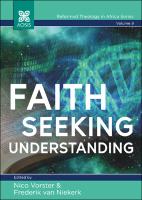
Faith seeking understanding
 Download
Contributor(s)
Vorster, Nico (editor)
van Niekerk, Frederick (editor)
Language
EnglishAbstract
The debate between faith and science is an ongoing and dynamic conversation marked
by the need to consistently factor in new data generated by the sciences, and new
perspectives developed in theology. In this book, a group of theologians and ethicists
provide insights into the debate from a faith perspective. The basic thesis permeating
the discussions is that faith and science are capable of enriching and complementing
each other, albeit in their own unique way. What unifies faith and science is the search
for truth. What differentiates them is the unique lenses they employ to find the truth.
In the end, both scientists and theologians must take into account all the pathways and
lenses that lead us to a better understanding of reality. This study presents concrete
examples of how theological knowledge and scientific data can be fruitfully used and
integrated to develop new horizons of understanding.
The general aim of this contribution was to narrow in on some of the burning themes
that are driving the faith or science scholarly debate. Each contributor highlights a
different aspect of the debate. The topics addressed include theoretical perspectives
on the science-faith relation, the ancient scientific worldview of the creation narratives
in Genesis, evolution and human origins, science and African Pentecostalism, faith and
the Fourth Industrial Revolution, science and transhumanism, science and traditional
medicine, and the role that faith and science can play in the human quest for meaning.
Most of the contributors approach the topic from a post-foundationalist and postpositivist
epistemological point of view. A wide range of hermeneutical methods is
employed, ranging from systematic biblical-theological perspectives to literary and
source criticism. Analytical, normative and existential philosophical arguments are also
utilised throughout the course of the book. The most important contribution of the
book lies in the transdisciplinary perspectives that emanate from the discussion. The
ways in which the authors go about integrating theological and scientific perspectives
to address ultimate questions about meaning and to inform moral discourse show
that religion still has an important role to play in a world increasingly shaped by
technological rationality. At the same time, it indicates that religion and science do not
have to stand in conflict with each other. If the two lenses on reality engage in mature
dialogue, they can enrich, inform and, on some occasions, even correct each other.
The target audience of this book includes theological scholars, natural scientists and
science philosophers.
This book contains no plagiarism, and none of the work has been published elsewhere.
Keywords
Faith; sciencd; theologyDOI
10.4102/aosis.2022.BK317ISBN
9781776342297, 9781776342273, 9781776342280Publisher
AOSISPublisher website
https://books.aosis.co.za/index.php/obPublication date and place
2022Series
Reformed Theology in Africa Series, 9Classification
Theology