
Logo Oapen
  • Join
    • Deposit
    • For Librarians
    • For Publishers
    • For Researchers
    • Funders
    • Resources
    • OAPEN
        View Item 
        •   OAPEN Home
        • View Item
        •   OAPEN Home
        • View Item
        JavaScript is disabled for your browser. Some features of this site may not work without it.

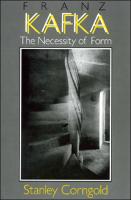
        Franz Kafka

        The Necessity of Form
        Thumbnail
        Download PDF Viewer
        Download
        Author(s)
        Corngold, Stanley
        Language
        English
        Show full item record
        Abstract
        In Stanley Corngold’s view, the themes and strategies of Kafka’s fiction are generated by a tension between his concern for writing and his growing sense of its arbitrary character. Analyzing Kafka’s work in light of "the necessity of form," which is also a merely formal necessity, Corngold uncovers the fundamental paradox of Kafka’s art and life. The first section of the book shows how Kafka’s rhetoric may be understood as the daring project of a man compelled to live his life as literature. In the central part of the book, Corngold reflects on the place of Kafka within the modern tradition, discussing such influential precursors of Cervantes, Flaubert, and Nietzsche, whose works display a comparable narrative disruption. Kafka’s distinctive narrative strategies, Corngold points out, demand interpretation at the same time they resist it. Critics of Kafka, he says, must be aware that their approaches are guided by the principles that Kafka’s fiction identifies, dramatizes, and rejects. ; In Stanley Corngold’s view, the themes and strategies of Kafka’s fiction are generated by a tension between his concern for writing and his growing sense of its arbitrary character. Analyzing Kafka’s work in light of "the necessity of form," which is also a merely formal necessity, Corngold uncovers the fundamental paradox of Kafka’s art and life. The first section of the book shows how Kafka’s rhetoric may be understood as the daring project of a man compelled to live his life as literature. In the central part of the book, Corngold reflects on the place of Kafka within the modern tradition, discussing such influential precursors of Cervantes, Flaubert, and Nietzsche, whose works display a comparable narrative disruption. Kafka’s distinctive narrative strategies, Corngold points out, demand interpretation at the same time they resist it. Critics of Kafka, he says, must be aware that their approaches are guided by the principles that Kafka’s fiction identifies, dramatizes, and rejects.
        URI
        https://library.oapen.org/handle/20.500.12657/62064
        Keywords
        Literature: history and criticism; Literary theory; Philosophy: logic
        DOI
        10.7298/j0zv-1b93
        ISBN
        9781501722813, 9781501722820, 9781501722813, 9781501727795, 9780801497681, 9781501722820, 9780801421990
        Publisher
        Cornell University Press
        Publisher website
        https://www.cornellpress.cornell.edu/
        Publication date and place
        Ithaca, 1990
        Grantor
        • National Endowment for the Humanities - [...] - Open Book Program
        Imprint
        Cornell University Press
        Classification
        Literary studies: fiction, novelists and prose writers
        Pages
        348
        Rights
        https://creativecommons.org/licenses/by-nc-nd/4.0/
        • Imported or submitted locally

        Browse

        All of OAPENSubjectsPublishersLanguagesCollections

        My Account

        LoginRegister

        Export

        Repository metadata
        Logo Oapen
        • For Librarians
        • For Publishers
        • For Researchers
        • Funders
        • Resources
        • OAPEN

        Newsletter

        • Subscribe to our newsletter
        • view our news archive

        Follow us on

        License

        • If not noted otherwise all contents are available under Attribution 4.0 International (CC BY 4.0)

        Credits

        • logo EU
        • This project received funding from the European Union's Horizon 2020 research and innovation programme under grant agreement No 683680, 810640, 871069 and 964352.

        OAPEN is based in the Netherlands, with its registered office in the National Library in The Hague.

        Director: Niels Stern

        Address:
        OAPEN Foundation
        Prins Willem-Alexanderhof 5
        2595 BE The Hague
        Postal address:
        OAPEN Foundation
        P.O. Box 90407
        2509 LK The Hague

        Websites:
        OAPEN Home: www.oapen.org
        OAPEN Library: library.oapen.org
        DOAB: www.doabooks.org


        Export search results

        The export option will allow you to export the current search results of the entered query to a file. Differen formats are available for download. To export the items, click on the button corresponding with the preferred download format.

        A logged-in user can export up to 15000 items. If you're not logged in, you can export no more than 500 items.

        To select a subset of the search results, click "Selective Export" button and make a selection of the items you want to export. The amount of items that can be exported at once is similarly restricted as the full export.

        After making a selection, click one of the export format buttons. The amount of items that will be exported is indicated in the bubble next to export format.