
Logo Oapen
  • Join
    • Deposit
    • For Librarians
    • For Publishers
    • For Researchers
    • Funders
    • Resources
    • OAPEN
        View Item 
        •   OAPEN Home
        • View Item
        •   OAPEN Home
        • View Item
        JavaScript is disabled for your browser. Some features of this site may not work without it.

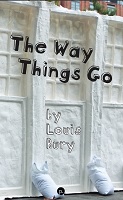
        The Way Things Go

        Thumbnail
        Download PDF Viewer
        Web Shop
        Author(s)
        Bury, Louis
        Collection
        ScholarLed
        Language
        English
        Show full item record
        Abstract
        The Way Things Go contains a mix of poetry, art writing, and life writing about anticipatory grief, or mourning someone or something before it’s gone. Each successive chapter in the book decreases in length by exactly one sentence, from a 71-sentence-long opening chapter, to a 70-sentence-long second chapter, to 69 sentences, 68 sentences, and so on down to 1 (a book-length Oulipian “melting snowball”). This shrinking form enacts the book’s concerns with loss, climate change, and the passage of time. At the level of its content, however, The Way Things Go is not fatalistic. Its title comes from a cult classic 1987 Fischli and Weiss film, in which objects such as bags of trash, car tires, and oil drums knock into one another in a Rube Goldberg-esque chain reaction. Moving through both personal history (his sister’s lupus and heroin addiction, his grandmother’s experience as a Holocaust survivor) and more global concerns (the Sixth Mass Extinction, COVID-19, the war in Ukraine), Bury considers the disruptions that occur as “things go,” as well as the continuity that remains. The book suggests that recent negotiations between optimism and pessimism with respect to the future reflect people’s feelings of vulnerability, particularly people who are used to taking their life’s stability for granted, in a world that seems increasingly precarious.
        URI
        https://library.oapen.org/handle/20.500.12657/76169
        Keywords
        climate change;addiction;experimental writing;art criticism;eco art;Oulipo;constraint-based writing;Sixth Mass Extinction
        DOI
        10.53288/0400.1.00
        ISBN
        9781685711191, 9781685711184
        Publisher
        punctum books
        Publisher website
        https://punctumbooks.com/
        Publication date and place
        Brooklyn, NY, 2023
        Grantor
        • Professional Staff Congress and City University of New York
        Pages
        301
        Rights
        https://creativecommons.org/licenses/by-nc-sa/4.0/
        • Imported or submitted locally

        Browse

        All of OAPENSubjectsPublishersLanguagesCollections

        My Account

        LoginRegister

        Export

        Repository metadata
        Logo Oapen
        • For Librarians
        • For Publishers
        • For Researchers
        • Funders
        • Resources
        • OAPEN

        Newsletter

        • Subscribe to our newsletter
        • view our news archive

        Follow us on

        License

        • If not noted otherwise all contents are available under Attribution 4.0 International (CC BY 4.0)

        Credits

        • logo EU
        • This project received funding from the European Union's Horizon 2020 research and innovation programme under grant agreement No 683680, 810640, 871069 and 964352.

        OAPEN is based in the Netherlands, with its registered office in the National Library in The Hague.

        Director: Niels Stern

        Address:
        OAPEN Foundation
        Prins Willem-Alexanderhof 5
        2595 BE The Hague
        Postal address:
        OAPEN Foundation
        P.O. Box 90407
        2509 LK The Hague

        Websites:
        OAPEN Home: www.oapen.org
        OAPEN Library: library.oapen.org
        DOAB: www.doabooks.org


        Export search results

        The export option will allow you to export the current search results of the entered query to a file. Differen formats are available for download. To export the items, click on the button corresponding with the preferred download format.

        A logged-in user can export up to 15000 items. If you're not logged in, you can export no more than 500 items.

        To select a subset of the search results, click "Selective Export" button and make a selection of the items you want to export. The amount of items that can be exported at once is similarly restricted as the full export.

        After making a selection, click one of the export format buttons. The amount of items that will be exported is indicated in the bubble next to export format.