
Logo Oapen
  • Join
    • Deposit
    • For Librarians
    • For Publishers
    • For Researchers
    • Funders
    • Resources
    • OAPEN
        View Item 
        •   OAPEN Home
        • View Item
        •   OAPEN Home
        • View Item
        JavaScript is disabled for your browser. Some features of this site may not work without it.

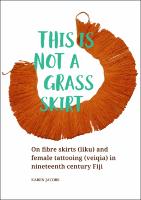
        This is not a grass skirt

        On fibre skirts (liku) and female tattooing (veiqia) in nineteenth century Fiji
        Thumbnail
        Download PDF Viewer
        Web Shop
        Author(s)
        Jacobs, Karen
        Language
        English
        Show full item record
        Abstract
        The Pacific ‘grass skirt’ has provoked debates about the demeaning and sexualised depiction of Pacific bodies. While these stereotypical portrayals associated with ‘nakedness’ are challenged in this book, the complex uses and meanings of the garments themselves are examined, including their link to other body adornments and modifications. In nineteenth-century Fiji, beautiful fibre skirts (liku) in a great variety of shapes and colours were lifetime companions for women. First fitted around puberty when she received her veiqia (tattooing), women’s successive liku were adapted at marriage and during maternity, performing a multiplicity of social functions. This book is based on a systematic investigation of previously understudied liku in museum collections around the world. Through the prism of one garment, multiple ways of looking at dress are considered, including their classification in museums and archives. Also highlighted are associated tattooing (veiqia) practices, perceptions of modesty, the intricacies of intercultural encounters and the significance of collections and cultural heritage today. The book is intended for those interested in often neglected women’s objects and practices in the Pacific, in dress and adornment more generally and in the use of museum collections and archives. It is richly illustrated with rare and previously unpublished paintings and drawings, as well as many examples of liku themselves.
        URI
        https://library.oapen.org/handle/20.500.12657/86389
        Keywords
        anthropology; fibre skirts; female tattooing; collecting; body adornment; community engagement with museum collections; Fiji
        ISBN
        9789088908125, 9789088908125, 9789088908132
        Publisher
        Sidestone Press
        Publisher website
        https://www.sidestone.com/
        Publication date and place
        Leiden, 2019
        Imprint
        Sidestone Press Academics
        Pages
        214
        Rights
        All rights reserved
        • Imported or submitted locally

        Browse

        All of OAPENSubjectsPublishersLanguagesCollections

        My Account

        LoginRegister

        Export

        Repository metadata
        Logo Oapen
        • For Librarians
        • For Publishers
        • For Researchers
        • Funders
        • Resources
        • OAPEN

        Newsletter

        • Subscribe to our newsletter
        • view our news archive

        Follow us on

        License

        • If not noted otherwise all contents are available under Attribution 4.0 International (CC BY 4.0)

        Credits

        • logo EU
        • This project received funding from the European Union's Horizon 2020 research and innovation programme under grant agreement No 683680, 810640, 871069 and 964352.

        OAPEN is based in the Netherlands, with its registered office in the National Library in The Hague.

        Director: Niels Stern

        Address:
        OAPEN Foundation
        Prins Willem-Alexanderhof 5
        2595 BE The Hague
        Postal address:
        OAPEN Foundation
        P.O. Box 90407
        2509 LK The Hague

        Websites:
        OAPEN Home: www.oapen.org
        OAPEN Library: library.oapen.org
        DOAB: www.doabooks.org


        Export search results

        The export option will allow you to export the current search results of the entered query to a file. Differen formats are available for download. To export the items, click on the button corresponding with the preferred download format.

        A logged-in user can export up to 15000 items. If you're not logged in, you can export no more than 500 items.

        To select a subset of the search results, click "Selective Export" button and make a selection of the items you want to export. The amount of items that can be exported at once is similarly restricted as the full export.

        After making a selection, click one of the export format buttons. The amount of items that will be exported is indicated in the bubble next to export format.