
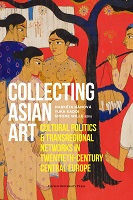
Collecting Asian Art
Cultural Politics and Transregional Networks in Twentieth-Century Central Europe
 Download
Contributor(s)
HÁNOVÁ, Markéta (editor)
Kadoi, Yuka (editor)
Wille, Simone (editor)
Collection
Austrian Science Fund (FWF); Knowledge Unlatched (KU); KU Open ServicesLanguage
EnglishAbstract
Museum collections of Asian art in Central Europe.
Rather than centering on the well-known collections in Western European and North American museums, Collecting Asian Art turns to museum collections of Asian art in Central Europe which emerged from the late 19th century onwards. Highlighting the dimensions of Central European connectedness, this volume explores how these collections evolved and changed under changing cultural and political conditions from the pre-World War I to the post-World War II periods. With a primary focus on collections of East Asian, South Asian, and West Asian art in Vienna, Prague, Berlin, Warsaw, Kraków, Budapest, and Ljubljana, it outlines the transregional connections and networks that gradually developed.
Collecting Asian Art locates Asian art across the twentieth-century in Central Europe via discourse and ideology, and discusses key collections and the way individual collectors built their networks. It thus explores transregional connections that developed through collecting activities and strategies in the prewar, interwar and postwar eras. Contributors also examine the personal connections between a group of Indologists from postwar Prague and modernist Indian artists from the early 1950s to the 1980s and also discuss the systematic archiving of East Asian art collections in Slovenia. A concluding conversation looks at colonisation and decolonisation from a broader perspective by approaching it through recent art historical discussions on the global dimensions of modernism. By defining the region through its external relationships and its entanglements with regions across Asia rather than as a self-contained unit, the contributions in this volume outline how these transregional connections and networks evolved and changed over time, thus highlighting their singularity in comparison to developments in Western Europe. Based on recent research, Collecting Asian Art reveals neglected sources while reinterpreting well-known ones.
Ebook available in Open Access.
This publication is GPRC-labeled (Guaranteed Peer-Reviewed Content). Contributors: Zdenka Klimtová (National Gallery in Prague); Agnieszka Kluczewska-Wójcik (Polish Institute of World Art Studies); Partha Mitter (University of Sussex); Michaela Pejčochová (National Gallery in Prague); Uta Rahman Steinert (Staatliche Museen zu Berlin); Iván Szántó (Eötvös Loránd University); Nataša Vampelj Suhadolnik (University of Ljubljana); Johannes Wieninger (MAK – Museum of Applied Arts); Tomáš Winter (Czech Academy of Sciences).
Keywords
Asian Art;Modern Art;Asian Art Collections;Museum Collections;Transregional approach;Post-war art developments;Post-colonial art historyDOI
10.11116/9789461665409ISBN
9789461665409, 9789462703780Publisher
Leuven University PressPublisher website
https://lup.be/Publication date and place
Leuven, 2024Grantor
Classification
History of art
East Asia, Far East